
TL;DR
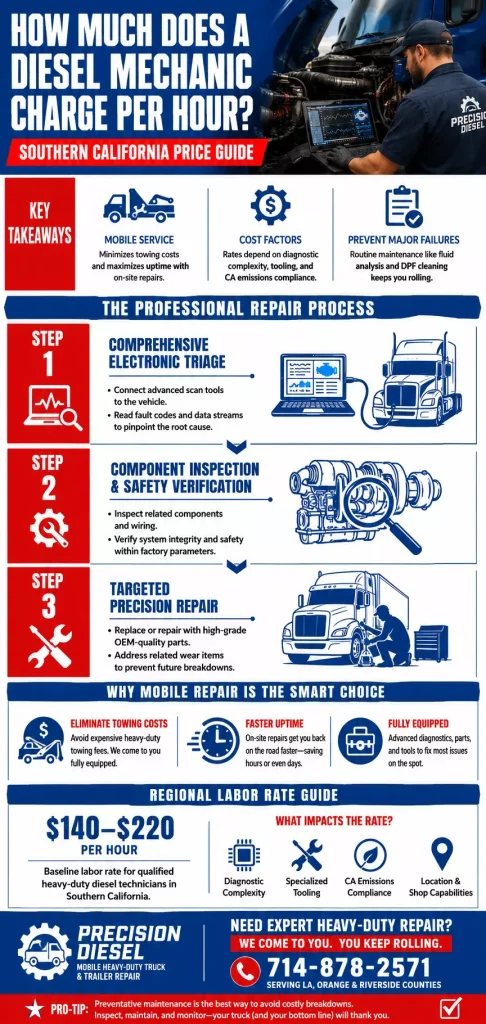
Heavy-duty truck repair in Southern California demands fast mobile response to beat high fleet downtime costs. This comprehensive guide breaks down regional labor rates, diagnostic procedures, and preventative maintenance strategies to help fleet managers and owner-operators control operational expenses.
Key Takeaways
- Mobile diesel technicians minimize expensive towing fees and maximize uptime by performing emergency roadside repairs directly on major transit corridors.
- Regional heavy-duty repair costs depend heavily on diagnostic complexity, specialized tooling, and compliance with strict California environmental regulations.
- Routine preventative maintenance like fluid analysis and diesel particulate filter cleaning prevents major roadside component failures.
The Reality of Commercial Fleet Operations in Southern California
Operating a commercial fleet or running as an owner-operator across the Southern California transportation landscape involves navigating some of the most demanding driving conditions in the nation. From the constant stop-and-go congestion along the I-710 freeway to the steep, punishing grades of the Cajon Pass and the Grapevine on the I-5, heavy-duty trucks face extreme mechanical stress every single day. When an engine component fails or a trailer brake system locks up near the Port of Long Beach, the financial consequences accumulate immediately. Understanding the underlying operational expenses, technician practices, and repair options is the most effective way to protect your bottom line.
A major concern for anyone managing a commercial vehicle is understanding the financial reality of unexpected mechanical failures. How much does a diesel mechanic charge per hour? This question sits at the center of budget planning for independent owner-operators and regional fleet managers alike. The answer varies based on location, the complexity of the diagnostic equipment required, and whether you are pulling into a traditional brick-and-mortar facility or utilizing an emergency mobile repair unit.
Deconstructing Regional Shop Labor Rates and Diagnostic Fees
The financial framework of commercial truck maintenance requires a close look at how service centers calculate billing. When evaluating regional options across the South Bay or the Inland Empire, you will encounter a wide spectrum of pricing models.
What is the labor rate for a diesel mechanic?
Commercial service billing reflects the advanced training and expensive tooling required to keep modern heavy-duty trucks compliant and operational. In the current market, the baseline labor rate for a qualified commercial vehicle technician generally ranges from 140 to 220 dollars per hour depending on the specific sub-zone and shop capabilities. Specialized diagnostic procedures involving proprietary software for engine control modules or advanced emissions systems typically settle at the higher end of that spectrum.
Is 150 an hour expensive for a mechanic?
When compared to standard passenger vehicle repair shops, a rate of 150 dollars per hour might initially seem high. However, within the heavy-duty commercial sector, this rate is highly competitive and often represents the standard baseline for qualified fleet maintenance. Commercial trucks rely on complex pneumatic systems, intricate high-pressure common rail fuel configurations, and heavily regulated exhaust aftertreatment systems that demand specialized expertise.
Is $100 an hour fair for mechanic labor?
Finding a heavy-duty commercial technician charging 100 dollars per hour in urban centers like Anaheim or Long Beach is increasingly rare. If you encounter a rate this low for commercial fleet service, it usually indicates a roadside generalist who may lack the factory diagnostic software, heavy lifting equipment, or specific certifications required to work on modern Class 8 vehicles. While it might save money on minor mechanical tasks, it often leads to longer troubleshooting times for complex electrical or emissions faults.
The True Cost Breakdown: Independent Shops vs. Dealerships vs. Mobile Fleet Units
When calculating your exact exposure for an unexpected breakdown or an engine check-light, the structural nature of the provider determines your final invoice. Here is the actual dollar breakdown of how those services compare across the industry:
| Service Provider Type | Average Hourly Labor Rate | Additional Billing Realities |
| Independent Truck Repair Shops | $130 – $180 / hour | Provides the most balanced combination of specialized heavy-duty expertise and cost-efficiency for regular fleet upkeep. |
| Commercial Dealerships | $200 – $275+ / hour | Highest rates due to specialized factory-grade diagnostic software, proprietary tooling, and mandatory OEM training programs. |
| Mobile & Roadside Mechanics | $150 – $250+ / hour | Reflects rapid response, custom service truck fuel overhead, and on-site tool transport directly to your stranded location. |
Factoring in Dedicated Diagnostic Fees
Before a single wrench turns on a complex electronic fault, a high-pressure fuel rail issue, or a problematic aftertreatment derate, an initial evaluation must happen. Most heavy-duty service operations charge a flat or increased diagnostic rate (frequently sitting at $150 – $195 flat, or a dedicated baseline hourly charge). This covers the cost of advanced commercial scan software licenses required to correctly pull codes and track down the precise root cause rather than throwing parts at a problem.
Furthermore, when utilizing mobile roadside assets to bypass a massive towing bill near shipping hubs like the Port of Los Angeles, be prepared for a flat “call-out fee” or a slightly elevated rate for the initial hour of field triage. This straightforward structural premium covers the immediate deployment of an advanced mobile workshop directly to a live highway shoulder or a warehouse yard.
The Financial Realities of Commercial Truck Upkeep
Budgeting for heavy-duty vehicle expenses requires a clear understanding of long-term operational costs versus immediate emergency interventions. Many fleet operators try to apply passenger car budgeting rules to commercial operations, which quickly leads to miscalculated margins.
What is the $3000 rule for cars?
In the consumer automotive world, the three thousand dollar rule suggests that if the annual cost of repairs exceeds three thousand dollars, or if a single repair estimate surpasses the actual cash value of the vehicle, it is time to replace the asset. For commercial transport, this rule is completely irrelevant. A single major engine overhaul or an emissions system replacement on a Class 8 truck can easily exceed ten thousand dollars, yet the asset remains highly profitable and capable of generating revenue for hundreds of thousands of miles more. Commercial fleet managers focus on cost-per-mile metrics rather than arbitrary flat-rate thresholds.
How expensive is diesel truck maintenance?
Maintaining a commercial truck is significantly more capital-intensive than maintaining gasoline-powered transport. On average, fleet operators should budget between 15,000 and 20,000 dollars annually per truck for routine preventative care, tires, compliance inspections, and expected component wear. This figure can escalate rapidly if high-mileage vehicles face unexpected forced regenerations, turbocharger failures, or transmission issues while tackling heavy cargo loads in the extreme summer heat of the Ontario logistics corridor.
Evaluating Engine Systems and Maintenance Profiles
Choosing the right equipment for your specific freight routes plays a massive role in dictating your long-term service expenses. Different powerplants come with unique service intervals, common failure points, and parts availability.
Which engine is cheaper to maintain?
When comparing major heavy-duty engine platforms like Cummins, Detroit Diesel, and PACCAR, maintenance costs generally track closely, but component availability varies. The Cummins ISX and X15 platforms often present a slightly lower total cost of ownership over time due to the widespread availability of aftermarket parts and universal familiarity among technicians. Detroit engines offer exceptional integration with Freightliner chassis, which can streamline diagnostic times, whereas certain European-designed PACCAR models may require specialized proprietary software that can increase diagnostic billing hours during troubleshooting.
Can a regular mechanic work on diesel trucks?
Attempting to utilize a standard automotive technician for a Class 8 commercial truck is a recipe for extended downtime and improper repairs. While basic mechanical concepts remain similar, heavy-duty trucks operate on completely different principles. A regular automotive technician is rarely equipped to handle air brake systems, high-displacement heavy-duty engines, complex multiplex wiring networks, or heavy structural components. True commercial service requires dedicated commercial technicians who understand federal safety regulations and possess the heavy-duty scan tools needed to communicate with advanced electronic control units.
Diesel Mechanic Earnings and Industry Standards
The cost of commercial service is directly tied to the specialized talent pool available in the region. Understanding the local economic pressures explains why commercial service rates sit where they do.
How much do diesel mechanics make in Southern California?
The high cost of living and the sheer concentration of freight moving through the Gateway Cities have created significant demand for skilled talent. Experienced heavy-duty technicians in urban areas like Los Angeles and Orange County typically earn between 35 and 55 dollars per hour as a base wage, with master diagnostic technicians and emergency night-shift mobile operators commanding even higher compensation. These competitive wages reflect the high level of technical competency required to minimize fleet downtime.
Troubleshooting Common Heavy-Duty Failure Points
To protect your equipment from sudden roadside failure, drivers must remain vigilant against early warning signs. Our technicians frequently encounter predictable failure patterns that could have been mitigated with early intervention.
Air Brake System Red Flags
If you notice your air compressor cycling more frequently than usual, or if your air pressure gauges drop rapidly during normal applications around the high-traffic corridors near Santa Ana, you are likely dealing with an audible air leak or a failing compressor governor. Ignoring these signs can lead to frozen brake chambers or a complete system lockup during transit.
Cooling System Vulnerabilities
Southern California summers place an immense thermal load on heavy-duty cooling packages. Our team typically sees a surge in cracked coolant reservoirs, leaking silicone hoses, and failing water pumps when trucks pull heavy loads up the Ortega Highway. A sudden rise in engine temperature should always prompt an immediate visual inspection of your fan clutch engagement and coolant levels.
Aftertreatment and DPF Distress
Modern emissions systems are highly sensitive to driving conditions. Constant stop-and-go traffic on the I-405 freeway prevents the exhaust system from reaching the high temperatures required to naturally burn off soot. If your dash indicates a need for a forced regeneration, ignoring the warning will quickly push the engine into a derate mode, locking the vehicle into a maximum speed of five miles per hour to protect the system from permanent damage.
The Strategic Advantage of Mobile Roadside Repair
When a truck breaks down on a busy shipping lane, the traditional response was to call a heavy-duty towing service to haul the vehicle to a physical shop. Today, smart fleet managers rely heavily on mobile service units to handle the problem directly on the shoulder or inside a warehouse yard.
Eliminating Towing Logistics
A heavy-duty tow from a location like the Irvine Spectrum area to a fixed shop can easily cost hundreds or thousands of dollars before any actual wrench is turned. Mobile repair units eliminate this middleman expense by bringing a fully equipped workshop on wheels directly to your location.
Accelerating Uptime
Our mobile technicians carry advanced computer diagnostic tools, common replacement parts, air compressors, and specialized heavy-duty tools directly to the field. Whether it is a blown wheel seal in Fontana or a faulty sensor causing an engine derate near Carson, fixing the issue on-site cuts hours, or even days, out of the repair timeline.
Understanding Precision Diesel Maintenance Protocols
When an emergency occurs or routine fleet service is due, our team executes a structured approach to get your equipment back into service safely and efficiently.
Step 1: Comprehensive Electronic Triage
Every mobile dispatch begins with connecting our heavy-duty diagnostic scan tools to the vehicle’s data port. This allows our technician to read active fault codes, evaluate historical data streams, and isolate the root cause of the mechanical or electrical disruption without guesswork.
Step 2: Component Inspection and Safety Verification
Once the electronic data pinpointed the fault, our team performs a physical inspection of the surrounding systems. For example, if an emissions fault code is present, the technician checks the wiring harness for chaffing, inspects the dosing valve for crystallization, and measures exhaust backpressure to ensure the entire system is functioning within factory parameters.
Step 3: Targeted Precision Repair
Our technicians proceed with the necessary parts replacement or system calibrations using high-grade components that meet or exceed original equipment manufacturer standards. We focus on fixing the core failure point while also addressing any secondary wear items that could cause a recurring breakdown down the road.
Emergency roadside service is an expensive necessity, but relying on it as a primary maintenance strategy will quickly drain a fleet’s operating margins. When a Class 8 truck breaks down on a major route like the I-710 or near the logistics hubs in Fontana, the final invoice reflects not just parts and labor, but the premium cost of emergency response, travel time, and highway safety risk.
To shift from reactive firefighting to controlled spending, fleet managers and owner-operators must implement a structured approach to asset management.
The Strategic Framework for Reducing Emergency Maintenance Costs
Minimizing call-out fees requires a two-pronged approach: hardening your equipment against predictable failures and structuring your service agreements so you never pay premium spot-market rates during a crisis.
1. Establish Scheduled Mobile PM (Preventative Maintenance) Contracts
The most effective way to eliminate emergency call-out fees is to turn those mobile visits into scheduled events. Instead of calling a technician when a component snaps, contract a mobile diesel provider to service your assets during scheduled terminal downtime.
- Yard-Basing: Arrange for technicians to perform routine “Dry” and “Wet” PM services (inspections, fluid changes, and lube services) at your yard or warehouse facility on weekends or during mandatory driver rest cycles.
- Fee Waiver Clauses: Many fleet-service contracts stipulate that if you commit to a minimum volume of scheduled preventative maintenance inspections per month, emergency call-out fees during unexpected breakdowns are either deeply discounted or completely waived.
2. Implement a High-Compliance Pre-Trip Inspection Protocol
The vast majority of roadside dispatches are triggered by faults that could have been identified visually during a thorough pre-trip inspection.
| Roadside Failure Category | Early Warning Sign (Pre-Trip Focus) | Preventive Action |
| Cooling System Failures | Small puddles beneath the engine, white residue around hose clamps, low reservoir levels. | Pressure-test the cooling system at every oil change interval; replace aging silicone hoses. |
| Wheel End & Brake Lockups | Oil splattering on inside wheel rims, audible air hissing during pre-charge, thin brake friction pads. | Check wheel seal integrity daily; measure brake stroke adjustments before hauling heavy grades. |
| Electrical / Lighting Outages | Chafed wiring harnesses near the 7-way plug, flickering marker lights, corroded battery terminals. | Clean battery connections before winter/summer temperature spikes; seal exposed wiring connections. |
3. Leverage Real-Time Telematics and Predictive Derate Alerting
Modern heavy-duty trucks rarely break down without warning. The engine control module (ECM) typically registers hidden fault codes or abnormal performance metrics hours before a critical failure occurs.
By utilizing remote telematics platforms, fleet managers can monitor active engine codes remotely. If a truck hauling a load through the Inland Empire triggers an early exhaust aftertreatment or fuel pressure fault code, you can reroute the vehicle to a local shop or terminal before the ECM triggers a restrictive engine derate that leaves the driver stranded on a live shoulder.
4. Consolidate into a Preferred Vendor Network
Relying on the closest random mechanic you find via an internet search during an emergency means you will pay top-dollar spot rates, premium diagnostic fees, and unchecked markup on parts.
Establishing a formal master service agreement (MSA) with a dedicated regional provider ensures predictable pricing. A structured agreement guarantees:
- Pre-negotiated flat-rate call-out fees (regardless of time of day or location within the service zone).
- Locked-in hourly labor rates for both shop work and field service.
- Priority dispatching over non-contracted customers during high-demand periods, such as severe regional heatwaves or major traffic disruptions.
When summer temperatures climb across the Inland Empire and desert freight corridors, standard pre-trip checks aren’t enough. High thermal loads and intense vibration accelerate the breakdown of cooling packages and electrical wiring harnesses on Class 8 vehicles.
Catching these issues in the yard prevents expensive roadside engine derates and emergency call-out fees.
High-Heat Engine Cooling & Electrical Pre-Trip Inspection
Phase 1: Engine Bay Cooling Architecture
Perform these checks with the engine off and cool during your morning walkaround.
- Coolant Reservoir & Cap: Inspect the pressurized surge tank for hairline cracks in the plastic. Check the seal inside the pressure cap; a failing cap cannot maintain system pressure, causing the coolant to boil at a lower temperature.
- Hose Matrix Evaluation: Squeeze the upper and lower radiator hoses, heater core lines, and EGR cooler supply hoses. Soft, spongy spots indicate internal wall degradation, while brittle sections are prone to blowing out under high heat. Look for white, crusty scaling around hose clamps.
- Radiator & Charge Air Cooler (CAC) Core: Inspect the frontal area of the cooling pack for packed road debris, bugs, or plastic wrap picked up from the freeway. Blocked airflow is the primary cause of overheating when pulling heavy grades like the Cajon Pass.
- Fan Clutch Engagement: Spin the fan blade manually with the engine off to check for smooth bearing rotation. Look for greasy residue radiating from the center of a viscous clutch, which signals a fluid leak that will prevent the fan from fully locking up when the engine reaches high operating temperatures.
Phase 2: High-Load Electrical Systems
Summer heat increases electrical resistance, making clean connections and solid wiring runs vital to preventing system failures.
- Battery Condition & Terminals: Open the battery box and check for green or white sulfate corrosion on the terminals. Ensure the hold-down brackets are tight; vibration destroys battery plates quickly in high temperatures.
- Alternator Output & Belt Tension: Check the alternator mounting bolts for security. Inspect the drive belt for cracks, fraying, or glazing (shiny spots). A slipping belt reduces alternator output and water pump efficiency.
- Wiring Harness Routing: Trace the main wiring harnesses running near the exhaust manifold, turbocharger, and EGR piping. High summer temperatures make plastic loom brittle. Ensure harnesses are securely clipped away from direct heat sources to prevent melted insulation and short circuits.
- The 7-Way Trailer Plug: Inspect the green ABS power cord and standard 7-way plug for loose pins or corrosion. Increased resistance here can trigger false trailer ABS fault codes or cause lighting circuits to cut out.
Pre-Trip Condition Action Plan
Use this reference table to determine if an identified issue requires immediate shop routing or if it can safely handle a local shift before servicing.
| Identified Condition | Diagnostic Risk Assessment | Required Action |
| Glazed or cracked serpentine belt | High risk of sudden snap, leading to total loss of power steering, cooling, and charging. | Do Not Roll: Replace the belt and check the automatic tensioner pulley immediately. |
| Dried coolant tracking around hose clamps | Minor weep that can expand rapidly under high cooling system pressure on mountain grades. | Tighten/Monitor: Secure the clamp, top off fluids, and route to a shop for pressure testing at the end of the shift. |
| Slight green corrosion on battery terminals | Increased electrical resistance that strains the alternator and causes electronic control module voltage drops. | Clean Asset: Clean the terminals with wire brush and baking soda solution before starting the engine. |
| Debris accumulation in radiator fins | Restricted air flow that steadily pushes engine oil and coolant temperatures into critical zones. | Clear Fins: Blow out the core from the inside out using low-pressure compressed air or water before hitting the road. |
When you are pulling a heavy load through challenging Southern California stretches like the Grapevine or up the Cajon Pass on the I-5, your dashboard gauges are your primary window into what is happening under the hood. Catching a failing engine cooling fan clutch early—before the electronic control module forces your truck into a restrictive engine derate—requires watching how your coolant and oil temperature gauges interact under load.
A heavy-duty engine cooling fan requires significant horsepower to turn, which is why it only engages when absolutely necessary. Recognizing the standard pattern of engagement versus a failure pattern can save you from a major roadside breakdown.
The Visual Profile: Reading Dash Gauges for Fan Engagement
Modern Class 8 trucks use either pneumatically controlled (air-engaged/spring-released) or electronically controlled viscous fan clutches. Under normal operating parameters, your temperature gauges should follow a predictable cycle.
The Normal Cooling Cycle
As you climb a grade, the engine coolant temperature will steadily rise. On most modern powertrains, when the coolant hits approximately 205 to 210 degrees Fahrenheit, the engine control unit triggers the fan clutch.
When the fan engages, you should notice two immediate indicators:
- The Audible Roar: A properly functioning heavy-duty fan creates a massive, unmistakable roar that you can easily hear inside the cab.
- The Needle Drop: Within 30 to 45 seconds of that roar starting, your dashboard coolant temperature gauge should stop climbing and visibly drop back down to around 185 to 195 degrees Fahrenheit.
Once the temperature drops, the fan disengages, the roar stops, and the cycle repeats as needed.
Diagnostic Scenarios: Identifying Roadside Fan Clutch Failures
If your fan clutch is failing, your dashboard gauges and vehicle behavior will display specific warning signs depending on how the clutch has failed.
Scenario A: The Fan Fails to Engage (The Slipping Clutch)
This is the most common and dangerous failure mode during the summer months. The engine requires maximum airflow, but the clutch cannot lock up.
- Gauge Behavior: As you pull a grade, your coolant temperature climbs past 210 degrees. It keeps going to 215, 220, and approaches the red zone at 225+ degrees Fahrenheit. Your engine oil temperature gauge will lag slightly behind but follow the same steep upward trajectory.
- What is Missing: You never hear the distinct mechanical roar of the fan kicking in, even as the temperature crosses the threshold where it should be running at 100 percent capacity.
- Roadside Diagnosis: The clutch is slipping internally—either due to a loss of air pressure to the hub, a failed electrical solenoid, or worn internal friction plates.
Scenario B: The Fan Fails to Disengage (The Locked Fan)
Some air-operated fan systems are designed to fail “on” as a safety mechanism. If the system loses air pressure entirely, a heavy internal spring forces the fan to lock up completely to prevent overheating.
- Gauge Behavior: Your engine coolant temperature stays unusually low, often struggling to reach normal operating temperature (staying around 170 to 180 degrees Fahrenheit), even when pulling a load on flat ground. Your fuel mileage metric will also show a sudden, noticeable drop.
- What you Hear: The fan roars constantly from the moment you start the engine, changing pitch directly with engine RPM, and never cycles off.
- Roadside Diagnosis: The fan is mechanically locked or has lost its air supply signal. While this will not cook your engine, it wastes significant fuel and robs the powertrain of usable horsepower.
Immediate On-Road Action Plan
If your gauges indicate that the fan clutch is failing to engage and your engine temperatures are climbing dangerously, take these steps immediately to protect the powertrain:
- Drop Gears to Raise RPM: If you are climbing a hill, downshift to drop your road speed but bring your engine RPM up into the 1600–1800 range. Higher RPM increases the speed of your water pump, circulating coolant faster through the radiator, which can buy you time.
- Turn Off the Air Conditioning: The A/C condenser sits directly in front of your radiator, dumping intense heat into the air before it ever touches your engine cooling core. Turning off the A/C stops this extra thermal load.
- Turn on the Bunk and Cab Heaters: Turn your cabin and sleeper berth heaters to maximum heat with the fans on high. The heater cores act like mini-radiators, drawing heat away from the engine block and blowing it into the cab. It will be uncomfortable, but it can drop engine temperatures by 5 to 10 critical degrees.
- Use Manual Fan Switches if Equipped: If your dash features a manual fan override switch, flip it to the “ON” position. If the temperature immediately begins to drop, your clutch is mechanically sound, but the automatic temperature sensor or ECM circuit has a signaling fault.
- Pull Over Before Derate: If the coolant temperature breaches 225 degrees Fahrenheit and shows no signs of stabilizing, safely pull over to the shoulder. Allowing the engine to reach full thermal derate can warp cylinder heads and score pistons, turning a basic clutch replacement into a catastrophic engine overhaul.
Common Heavy-Duty Truck Repair Questions
What are the main causes of sudden engine derate?
An engine derate is a safety mechanism designed to protect the powertrain from catastrophic failure. The most common triggers include exhaust aftertreatment restrictions (such as a plugged DPF), faulty exhaust gas recirculation valves, low coolant levels, or a sudden loss of fuel rail pressure.
How often should commercial wheel seals be inspected?
Wheel seals should be checked during every pre-trip inspection for signs of weeping or visible oil sling on the inner wheel rim. A failing wheel seal can quickly contaminate brake shoes, leading to reduced stopping power and potential wheel-end fires due to friction build-up.
Why is fuel filter maintenance critical for common rail systems?
Modern high-pressure common rail fuel systems operate at pressures exceeding 30,000 psi. Even microscopic dirt particles or water contamination can destroy expensive fuel injectors and ruin high-pressure pumps. Replacing fuel filters at every scheduled oil drainage interval is cheap insurance against system failure.
Professional Mobile Heavy-Duty Support
Navigating commercial vehicle maintenance requires balancing immediate breakdown response with rigorous preventative care. Fleet operators must understand exactly what goes into professional diagnostic billing to make informed operational decisions that safeguard their supply chain commitments.
When your fleet encounters unexpected mechanical hurdles or requires dependable on-site upkeep anywhere across Los Angeles County, Orange County, Riverside County, or the surrounding shipping corridors, Precision Diesel Mobile Heavy-Duty Truck and Trailer Repair provides the immediate on-site technical expertise required to resolve your issues. Our mobile service trucks operate out of strategic locations including La Palma, Huntington Beach, El Segundo, and Newport Beach to ensure rapid response times on major routes. For dependable heavy-duty roadside intervention or to schedule routine fleet maintenance at your facility, contact our team directly at 714-878-2571 to speak with a commercial diesel technician.
