
TL;DR
When your commercial truck breaks down, your top priorities are moving to a safe location, activating hazard lights, and properly placing warning triangles. A qualified mobile diesel mechanic can often resolve common issues like fuel, cooling, and air system failures on-site, which avoids the high costs and downtime associated with heavy-duty towing. Prioritizing routine preventative maintenance and recognizing early warning signs significantly reduces the risk of emergency failures on the road.
Key Takeaways
- Safety First: Prioritize moving the truck to a wide, visible section of the shoulder and activate all warning devices immediately.
- Accurate Diagnosis: Pay close attention to early warning signs like specific dashboard lights, unusual air drops, or changes in engine sound before total failure occurs.
- Understand Maintenance Costs: Routine preventative care is far more cost-effective than emergency roadside towing and component replacement.
- Emissions Matter: Modern diesel exhaust fluid systems require strict maintenance, and understanding them prevents forced engine derates on the road.
- Professional Support: Having access to a dependable mobile diesel mechanic saves hours of downtime by fixing the truck on-site.
If you operate a commercial truck or manage a fleet in Southern California, you already know that a mechanical failure on the highway is never just a minor inconvenience. A breakdown on a major freight corridor like the I-5 or the I-710 can quickly spiral into a dangerous, high-stress situation that threatens your safety, your cargo, and your bottom line. Getting stranded on a narrow shoulder with eighty thousand pounds of equipment means you need reliable help, and you need it fast.
When your vehicle experiences a sudden loss of power, a cooling system failure, or a severe air brake leak, knowing exactly how to handle those first few moments makes all the difference. Our crew of professional technicians at Precision Diesel Mobile Heavy-Duty Truck and Trailer Repair responds to these road emergencies every single day. We understand the specific mechanical vulnerabilities of working trucks under heavy loads and the immense pressure drivers face to keep their wheels turning.
This comprehensive guide breaks down the essential steps to manage a heavy-duty highway emergency safely. It also covers practical troubleshooting tips for common diesel systems and explains how a skilled mobile diesel mechanic can get your equipment back in service right where it sits.
The Reality of Roadside Breakdowns in Southern California
Operating a commercial vehicle in the South Bay, the Inland Empire, or across the Gateway Cities exposes your truck to some of the most demanding driving conditions in the country. The constant stop-and-go congestion on the LA freeway system causes rapid wear and tear on braking systems and emissions components. Meanwhile, hauling heavy freight up brutal elevation changes like the Cajon Pass or the Grapevine on the I-5 puts tremendous thermal stress on your engine and transmission.
Southern California Driving Stress
| LA Freeway Congestion | Severe Stop-and-Go Brake Wear |
| Cajon Pass / Grapevine | Extreme Engine & Thermal Stress |
| Inland Empire Summers | Cooling System & Fan Failures |
When an emergency happens in these high-traffic areas, structural safety and rapid response are critical. A breakdown near the Anaheim corridors or around the Port of Los Angeles requires immediate action to protect the driver and prevent a costly logjam. Understanding how to handle your truck during a mechanical failure can prevent a minor part malfunction from turning into a major highway accident.10 Critical Steps During a Heavy-Duty Highway Emergency
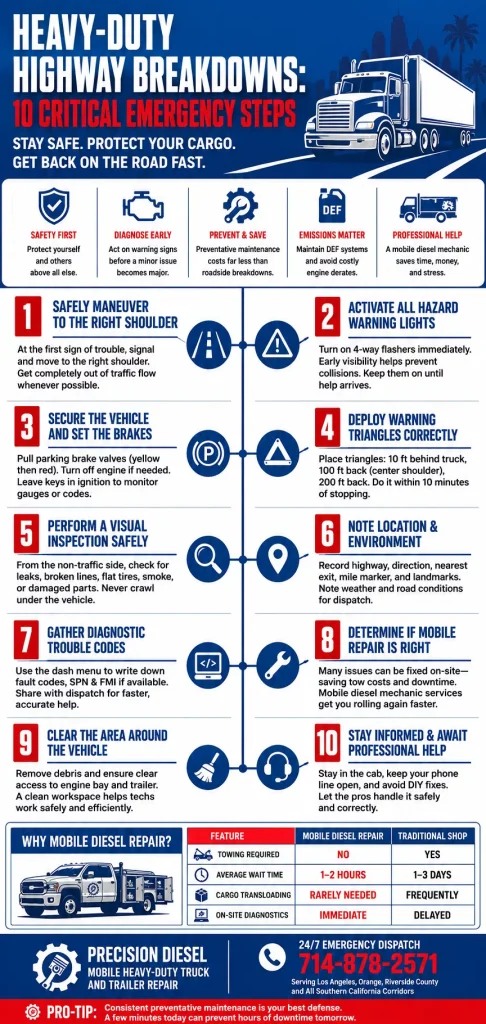
1. Safely Maneuver to the Right Shoulder
The moment your engine stumbles or an air pressure warning buzzer sounds, look for a safe place to pull over. Do not wait for the vehicle to stop completely on its own if you can avoid it. Safely signal and guide the truck toward the right shoulder, aiming for a straight section of the highway rather than a blind curve. If you are near a major hub like the Port of Long Beach or a busy commercial zone in Fontana, try to exit the main lanes entirely. Getting the vehicle completely out of the flow of traffic is the most important step for your safety and the safety of oncoming drivers.
2. Activate All Hazard Warning Lights
Turn on your 4-way flashers immediately, even before you come to a complete stop. This gives immediate visual warning to surrounding traffic that your heavy-duty truck or box truck is experiencing a major issue. In the heavy traffic common to areas like Santa Ana or Long Beach, early visibility is your best defense against rear-end collisions. Leave these hazard lights operating throughout the entire breakdown event so that law enforcement and roadside assistance crews can locate your position easily.
3. Secure the Vehicle and Set the Brakes
Once the truck is fully on the shoulder, pull the yellow parking brake valve to lock the tractor brakes and the red valve for the trailer. If your air system is rapidly losing pressure, the spring brakes may apply automatically, so ensure the vehicle is firmly positioned where you want it before that occurs. Turn off the engine if you suspect a major mechanical failure, such as low oil pressure or severe overheating. Keep your keys in the ignition so you can monitor dashboard gauges or pull diagnostic codes if necessary.
4. Deploy Your Warning Triangles Correctly
Federal motor carrier regulations require drivers to deploy warning devices within 10 minutes of stopping on the shoulder. Place your three reflective triangles at specific intervals behind your trailer to give oncoming traffic plenty of advance notice. On a divided highway or a straight one-way road, place the first triangle 10 feet behind the truck on the traffic side. Put the second triangle 100 feet back in the center of the shoulder, and place the third triangle 200 feet back.
5. Perform a Visual Inspection from a Safe Position
If it is safe to exit the cab, step out on the non-traffic side of the truck to assess the problem. Walk around the vehicle carefully, looking for obvious signs of trouble like fluid puddles, broken air lines, flat tires, or smoke. Check under the hood for broken serpentine belts, ruptured coolant hoses, or displaced turbocharger boots. Do not attempt to crawl underneath the truck or perform complex mechanical work on a live highway shoulder where passing traffic is moving at high speeds.
6. Note Exact Location and Environmental Conditions
Before calling for assistance, pinpoint your exact geographical coordinates or reference points. Note the specific highway or freeway number, your direction of travel, the nearest exit ramp, and prominent landmarks. For instance, knowing you are broken down on the SR-91 eastbound just past the junction for the I-405 helps a dispatch team route help directly to you. Pay attention to the current weather conditions, such as high midday temperatures in the Inland Empire or heavy evening fog along the coastal routes near Newport Beach.
7. Gather Dashboard Diagnostic Trouble Codes
Modern heavy-duty trucks utilize electronic control units to manage engines, transmissions, and braking systems. If your check engine light or malfunction indicator lamp is illuminated, use the dashboard display interface to navigate to the diagnostics menu. Write down the specific fault codes, including the Suspect Parameter Number and Failure Mode Identifier if available. Providing these precise codes to our dispatch desk allows our technicians to understand the exact electrical or mechanical failure before they even arrive at your location.
8. Determine if Mobile Repair is the Right Choice
Many common roadside failures can be successfully repaired on the shoulder by a qualified technician, saving you the high cost of a heavy-duty tow. Issues involving blown coolant hoses, ruptured air brake lines, failed sensors, and frozen brake calipers are ideal candidates for on-site service. Opting for professional mobile diesel mechanic services allows you to avoid long wait times at busy brick-and-mortar repair shops. This approach keeps your trailer attached to your tractor and prevents the logistical headache of cargo transloading.
9. Clear the Area Around the Vehicle Damage
If you are waiting for a technician to arrive to handle a box truck repair or trailer fix, prepare the workspace if it is safe to do so. Clear away any loose debris from around the wheels or the engine bay area. If your trailer doors are blocked or you have a cargo issue, ensure you have clear access to the rear of the vehicle. Keeping the area clean and accessible allows the incoming repair crew to set up their specialized tools and start working on the mechanical issue immediately upon arrival.
10. Stay Informed and Await Professional Assistance
While waiting for roadside assistance, remain inside the secure cab of your truck with your seatbelt fastened if the shoulder is narrow or dangerous. Keep your phone line clear so the arriving technician or dispatcher can contact you with updates on their estimated arrival time. Avoid trying to implement temporary fixes with improper tools, as this can often worsen the underlying mechanical issue or cause personal injury. Let the professional emergency response team handle the heavy lifting safely.
Common Mechanical Failures on the Road
Understanding why commercial trucks break down helps drivers identify early warning signs before a catastrophe happens. Our field service trucks regularly encounter specific mechanical issues that are highly prevalent throughout Southern California’s demanding transport routes.
Fuel System and Delivery Problems
Diesel engines rely on high-pressure fuel systems to deliver fuel efficiently to the cylinders. A plugged fuel filter can cause sudden engine stalling, hard starting, or a noticeable drop in power when pulling a heavy load up an incline like the Ortega Highway. Drivers should regularly check their primary fuel-water separators for visible sediment or water contamination. If your engine is cranking normally but refusing to catch, a failed fuel lift pump or an air leak in the suction lines is often the culprit.
Cooling System Weaknesses
The combination of intense Southern California summer heat and heavy cargo weight puts tremendous strain on the radiator and cooling lines. A small hairline crack in a plastic coolant expansion tank or a worn radiator hose can lead to a rapid loss of engine coolant. When the coolant level drops below a critical threshold, the engine control module will typically trigger a protective engine shutdown to prevent permanent cylinder head warping or engine seizure.
Cooling System Failure Cascade
| Minor Hose Crack / Leak | Rapid Loss of Coolant |
| Temperature Spike | Dashboard Warning Light |
| ECM Forced Derate | Total Roadside Shutdown |
Our technicians frequently see failed fan clutches that refuse to engage when engine temperatures climb past normal operating ranges. If you notice your temperature gauge creeping steadily upward while stop-and-go driving near the Irvine Spectrum area, pull over safely before the system boils over completely.Air Brake and Suspension Leaks
Heavy-duty trucks rely completely on compressed air to operate their foundational braking systems and air ride suspensions. Constant vibration can cause nylon air lines to rub against the frame rails, eventually wearing a hole through the tubing and causing a major air leak. If your air compressor cannot maintain system pressure above 90 PSI, your trailer brakes will begin to drag, generating extreme friction and dangerous wheel-end heat. Regularly draining your air tanks during pre-trip inspections helps prevent moisture buildup from corroding internal brake valves.
Technical Breakdown: Troubleshooting and Repair Advice
When a truck breaks down, a methodical diagnostic approach prevents unnecessary part replacement and gets to the root cause of the issue faster.
Dealing with Forced Engine Derates
A forced engine derate is one of the most frustrating experiences for a driver. This occurs when the vehicle’s engine computer intentionally limits power and vehicle speed to protect components or comply with emissions laws. This is often triggered by an issue within the Selective Catalytic Reduction system or a clogged Diesel Particulate Filter. If your dashboard displays a flashing DEF light or an emissions failure icon, ignoring it will eventually drop your maximum speed down to 5 miles per hour.
Emissions Derate Sequence
| Fault Detected | Warning Light | Power Reduced 25% | Speed Capped at 55 MPH | Final Derate (5 MPH max) |
Our technicians utilize advanced diagnostic laptops to connect directly to your truck’s data port. They can force a manual park regeneration on the shoulder to clear out soot buildup or replace faulty NOx sensors on the spot, resetting the computer and restoring full engine power.Aftermarket Component Considerations
Many owner-operators face a difficult choice when it comes to engine platforms, often debating whether a Cummins or Duramax engine architecture suits their operational needs better. Cummins engines are highly prevalent in Class 8 heavy-duty over-the-road tractors, offering robust inline-six configurations that excel at long-haul pulling power and high-mileage durability.
On the other hand, the Duramax V8 platform is widely utilized in medium-duty commercial applications, local delivery box trucks, and hotshot hauling setups across Southern California. Our mobile service trucks carry diagnostic software and replacement parts tailored for both engine platforms, ensuring we can handle any fuel injector, turbocharger, or electrical issue regardless of your specific powertrain layout.
Clear Answers to Common Fleet Questions
To help drivers and fleet managers understand the real costs and logistical realities of operating modern commercial vehicles, we have provided straightforward answers to several critical industry questions.
How expensive is diesel truck maintenance?
The overall cost of keeping a commercial diesel truck properly maintained depends heavily on your duty cycle, cargo weights, and preventative care habits. On average, fleet managers typically budget between fifteen thousand and twenty-five thousand dollars annually per Class 8 tractor for routine preventative maintenance, tire replacements, and unexpected mechanical repairs. While this figures out to a significant operating expense, it is far less costly than dealing with catastrophic engine failures or emergency towing fees resulting from deferred service.
Are diesel trucks expensive to maintain?
Yes, diesel trucks do carry higher maintenance costs than traditional gasoline-powered commercial vehicles. This cost difference is driven by several factors, including larger fluid capacities, heavy-duty engines often require ten to twelve gallons of specialized engine oil per oil change, expensive heavy-duty fuel filters, and highly intricate exhaust emissions treatment systems. Additionally, the specialized diagnostic equipment and technical training required to accurately troubleshoot modern diesel electronics command a premium labor rate in the marketplace.
Is it worth owning a diesel truck?
For businesses and operators hauling heavy loads, pulling trailers over long distances, or running high-mileage duty cycles, a diesel truck remains absolutely essential. The fundamental engineering advantages of a diesel engine, specifically its ability to produce massive torque at low engine RPMs and its superior fuel efficiency under load, make it far more productive than a gasoline equivalent for serious commercial transport. The extended operational lifespan of a diesel engine block, which can often run for hundreds of thousands of miles before requiring a major overhaul, justifies the higher initial acquisition and maintenance costs.
What are the downsides of owning a diesel?
The primary downsides of operating modern diesel equipment center around complex emission compliance components and initial repair expenses. Systems like the Diesel Particulate Filter, Exhaust Gas Recirculation valves, and Selective Catalytic Reduction units require ongoing monitoring and add multiple failure points to the vehicle. Furthermore, components like high-pressure fuel injectors, variable-geometry turbochargers, and heavy-duty air compressors are expensive to replace when they wear out or suffer from poor oil maintenance habits.
Are diesels ok for short journeys?
Generally, modern diesel engines equipped with advanced emissions systems do not perform well when restricted exclusively to short, local trips. Short journeys with frequent stops prevent the engine and exhaust system from reaching their optimal operating temperatures. Without sufficient heat, the Diesel Particulate Filter cannot burn off accumulated soot naturally, leading to rapid soot loading, frequent dashboard regeneration requests, and eventual exhaust system clogging. If your fleet runs local pickup and delivery routes around dense urban environments like downtown Los Angeles or Torrance, it is crucial to take the trucks on regular highway runs to clear out the emissions system, or establish a strict preventative maintenance schedule with an experienced technician.
Is DEF going away for diesels?
No, Diesel Exhaust Fluid is not going away for commercial diesel vehicles anytime soon. Environmental regulatory agencies, including the California Air Resources Board, maintain strict standards for reducing nitrogen oxide emissions from commercial transport vehicles. DEF is the primary agent used within Selective Catalytic Reduction systems to break down dangerous emissions into harmless nitrogen and water vapor. As a result, maintaining your DEF system and utilizing high-quality fluid remains a non-negotiable part of operating a compliant commercial diesel fleet in California.
Choosing the Right Roadside Support
When you are facing a mechanical breakdown on a busy Southern California route, finding the right emergency assistance can make the difference between a quick turnaround and a ruined delivery schedule. Drivers often search online for a truck mechanic near me or look up commercial truck mechanics near me to locate immediate help. Selecting a provider that specializes in dedicated mobile dispatch means you receive a technician who arrives in a fully equipped service vehicle, ready to perform heavy mechanical work right on the shoulder.
Repair Service Comparison
| Feature | Mobile Diesel Repair | Traditional Shop |
| Towing Required | No | Yes |
| Average Wait Time | 1-2 Hours | 1-3 Days |
| Cargo Transloading | Rarely Needed | Frequently |
| On-Site Diagnostics | Immediate | Delayed |
Instead of waiting for a costly tow truck to transport your vehicle to stationary semi truck repair shops near me, a professional semi truck mechanic near me can handle your diagnostic and repair needs on-site. Utilizing a dedicated mobile semi truck repair near me service minimizes your overall equipment downtime, eliminates tow fees, and allows you to keep your cargo secure inside your trailer while the repair is performed.Preventative Maintenance Checklists for Fleets
The most effective way to manage a highway emergency is to prevent it from happening in the first place. Implementing structured, regular inspection routines keeps your trucks reliable and helps you catch minor component wear before it leads to a major roadside breakdown.
Daily Pre-Trip Inspections
Drivers should always dedicate ten to fifteen minutes before every trip to perform a thorough walkaround inspection of their vehicle. This routine check is highly effective at identifying small, developing issues that could easily turn into a major hazard under highway conditions.
- Fluid Level Checks: Verify engine oil, coolant, power steering, and windshield washer fluid levels are within safe operating limits.
- Belt and Hose Inspection: Inspect the serpentine belt for signs of cracking or fraying, and squeeze radiator hoses to check for unusual softness or brittle sections.
- Air Brake System Test: Start the engine, charge the air system to maximum pressure, and perform an air loss leakage test to ensure your lines are intact.
- Tire and Wheel Check: Look for low inflation pressures, embedded road debris, deep sidewall gouges, and loose wheel lug nuts on both the tractor and trailer.
- Lighting and Visibility: Test all headlights, high beams, turn signals, brake lights, and clearance markers for proper operation.
Comprehensive 90-Day Scheduled PM Service
Every three months, commercial trucks should undergo a more rigorous, in-depth preventative maintenance service. This thorough inspection allows a professional technician to evaluate internal component health and replace wear items before they cause a breakdown on routes like the I-5 or I-710.
- Oil and Filter Replacement: Drain old engine oil and replace it with high-grade lubricant, and install fresh oil, fuel, and water separator filters.
- Chassis and Driveline Lubrication: Apply fresh grease to all steering knuckles, tie rod ends, u-joints, slip joints, and fifth wheel pivot points.
- Brake Component Measurement: Measure brake shoe linings or pad thicknesses, inspect brake drums or rotors for heat cracking, and check slack adjuster travel.
- Electrical System Load Test: Clean battery terminals to remove corrosion, verify secure ground connections, and perform a load test on the batteries and alternator.
- Exhaust and Emissions Evaluation: Inspect the entire exhaust piping run for leaks, check DEF tank lines, and check for any active or pending fault codes in the engine computer.
Common Mechanical Issues and Roadside Solutions
To give you a better idea of how our team approaches roadside repair work in the field, here is a quick reference table outlining common mechanical failures, their typical symptoms, and how our technicians handle them on-site.
| System | Specific Failure | Common Roadside Symptoms | Mobile Repair Solution |
| Fuel System | Clogged Fuel Filter | Engine stumbling, loss of power under load, hard starting. | Replace primary and secondary filters, prime fuel system, clear codes. |
| Cooling | Blown Radiator Hose | Rapid temperature spike, steam from hood, low coolant light. | Cut away damaged section or replace hose, pressure test system, refill coolant. |
| Electrical | Failed Alternator | Dimming dash lights, voltage gauge dropping below 12V, battery light. | Test charging system, replace alternator on-site, clean and jump-start batteries. |
| Air Brakes | Ruptured Air Line | Audible air hiss, compressor unable to build pressure past 90 PSI. | Cut out damaged line section, install high-quality push-to-connect union splice. |
| Emissions | Clogged DPF / Faulty Sensor | Flashing DEF light, engine derate warning, maximum speed capped. | Connect diagnostic software, replace faulty NOx sensor, force manual park regen. |
Professional On-Site Commercial Support
When your commercial truck or fleet vehicle encounters an unexpected mechanical breakdown on the road, you do not have to navigate the challenge alone. Getting professional, reliable support right at your location can turn a stressful highway emergency into a manageable service stop.
Our team at Precision Diesel Mobile Heavy-Duty Truck and Trailer Repair provides dependable, highly responsive commercial vehicle care across Southern California. Our skilled technicians handle everything from emergency engine diagnostics and air brake fixes to complex trailer repairs and forced emissions regenerations. We travel directly to your location with the proper tools and diagnostic software to complete the work safely on-site, eliminating the need for expensive towing services.
Whether you are dealing with an unexpected engine derate near the Port of Los Angeles, a cooling system failure along the I-5 corridor, or an air leak in a distribution lot in Fontana, our mobile service trucks are ready to assist. You can reach our dispatch line at 714-878-2571 to connect with our emergency repair team. We proudly support owner-operators and fleet managers throughout Los Angeles County, Orange County, Riverside County, and all surrounding Southern California logistics corridors.
To ensure convenient coverage for your regular service needs, our established diesel repair shops are located in La Palma, Huntington Beach, El Segundo, and Newport Beach. Contact us whenever you need expert, practical mechanical support to keep your commercial vehicles operating safely and efficiently.
