

TL;DR
Battery operated semi trucks are rapidly emerging as the future of freight because they offer zero emissions, lower operating costs, and improved driving performance compared to diesel trucks. Companies like Tesla, Volvo Trucks North America, and Nikola Corporation are leading innovation with longer driving ranges, advanced safety systems, and smarter charging solutions. While challenges like charging infrastructure and high upfront costs remain, advances in battery technology and government incentives are accelerating adoption across the freight industry.
Key Takeaways
- Electric semi trucks use battery power instead of diesel, producing zero tailpipe emissions.
- Key benefits include lower fuel costs, reduced maintenance, quieter operation, and instant torque for smoother driving.
- Advanced lithium batteries and regenerative braking improve energy efficiency and driving range.
- Tesla focuses on long-range trucking and active safety features, including up to 500 miles per charge.
- Volvo Trucks North America and Freightliner prioritize sustainability, driver comfort, and operational reliability.
- Charging infrastructure remains a major challenge, especially the lack of high-power charging stations along freight routes.
- Companies like TravelCenters of America are investing in fast-charging hubs to support electric trucking adoption.
- Fleet operators can ease the transition through phased implementation, route planning, and government incentives.
- Electric trucks include advanced safety technologies such as collision avoidance, lane keeping, and battery monitoring systems.
- Future improvements in battery density, charging speed, and smart grid integration are expected to make electric freight transport more practical and cost-effective.
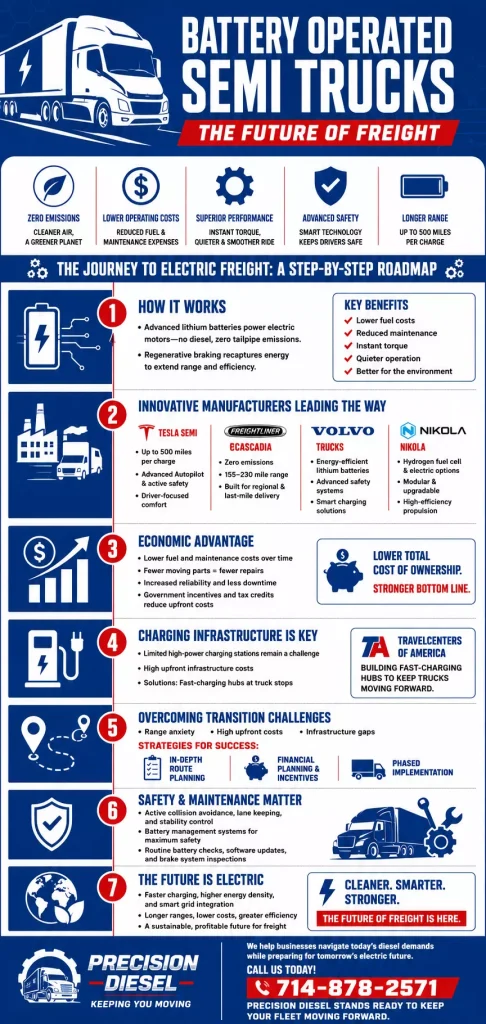
The statement is in the making: battery-driven semi-trucks are the future of freight. Since they are cleaner and more efficient than their diesel-powered ancestors, electric trucks will eventually be the standard. Massive initiatives like those from Tesla and Volvo have led to this innovation. For Tesla, electric semi trucks are about active safety features and long driving distances, while for Volvo, it’s all about reliability and environmental sustainability. Equipped with advanced technology, both companies set the bar for what battery-operated semi trucks can do, setting the course for a much greener future in freight transport.
Battery Operated Semi Trucks: Understanding Them
Definition and Major Characteristics of Battery-Operated Semi Trucks
Battery-operated semi trucks, more often referred to as electric semi trucks or commercial electric vehicles, represent high-powered transporters powered by electric batteries rather than conventional diesel fuel. The trucks are made in such a way that they have equal hauling capabilities as their diesel counterparts but bring forth very relevant environmental and operational benefits. The key characteristics include zero emissions, lower noise levels, and reduced operational costs.
Comparison to Traditional Diesel Engines
In comparison to conventional diesel engines, electric semi trucks have the following performance and environmental impacts:
- Performance: Electric trucks naturally deliver instant torque from the motors, which translates to quicker acceleration and less jerky driving. Many diesel engines lag in acceleration since the fuel combustion is much slower.
- Environmental Impact: Diesel engines greatly emit greenhouse gases and air pollutants into the atmosphere. On the other hand, electric semi-trucks do not yield tailpipe emissions.
Electric semi-trucks do not yield tailpipe emissions, which also applies to battery powered semi trailers used in certain logistics fleets.
How Electric Trucks Work Using Advanced Lithium Battery Technology
Electric semi-trucks make use of advanced lithium battery technology to store energy. These batteries can be recharged with energy in a number of ways, such as by making use of high-power charging stations designed for heavy-duty vehicles.
- Lithium Batteries: Because of their high energy density, lithium batteries offer a decent range of long hauls, significantly more so than conventional lead-acid batteries.
- Regenerative Braking: Most electric trucks come with regenerative braking systems that capture energy during braking and feed it back into the battery for extended range and efficiency in the vehicle.
Understanding these key points shows that battery-powered semi trucks have great potential to disrupt the freight transport sector with their greener and more productive alternatives compared to diesel-powered ones.
Key Manufacturers and Their Innovations in Electric Trucks
Tesla Semi
This is a huge feature of Tesla’s entry into the electric semi-truck market, which is called Tesla Semi. This vehicle focuses on active safety features to avoid accidents and keep the driver safe. The Tesla Semi has great driving ranges that target long-haul trucking demand. Advanced design features of this truck include:
- Increased Autopilot: Enables automatic lane-keeping and braking.
- Spacious Interior: Comfort for drivers over extended routes.
- Electric Range: Boasts as far as 500 miles on a single charge.
Freightliner eCascadia
The Freightliner eCascadia boasts zero emissions with extended-range capabilities. This truck, built by Daimler Trucks North America, is designed to be efficient for regional and last-mile delivery applications. Key characteristics include:
- Zero Emission Profile: Assists with meeting the strictest environmental policies of organizations.
- Range Options: Ranges from 155 to 230 miles on a single charge, depending on the size of the battery configuration.
- Advanced Driver Comfort Technologies: This includes ergonomic seating and intuitive control systems.
Volvo Trucks North America
Volvo Truck is also one of the major contributors to the electric truck industry. The models and their design maintain high performance while the sustainability standards are not compromised. Volvo Trucks North America is in the development of innovations that include:
- More Energy-Efficient: Makes use of advanced lithium-ion batteries.
- Increased Safety Features: Collision avoidance and lane departure warnings are integrated into its systems.
- Smart Charging Solutions: Innovations that contribute to reducing downtime by efficient charging methods.
Nikola Corporation
After Tesla, the second significant driver in electric truck technology is Nikola Corporation. This is mainly known for its hydrogen-electric hybrid trucks, although recently, it has also started offering fully electric trucks. New areas that Nikola has been working on involve the following:
- Hydrogen Fuel Cell Technology: Offers an alternative to pure battery electric designs and extends the range capability.
- Modular Design: Upgradable and maintainable easily.
- Innovative Propulsion Systems: These are used to improve the overall efficiency of the whole vehicle and reduce operational costs.
These leading manufacturers will pave the path into the future of freight transportation with their innovative electric semi trucks, each bringing their strength to market.
Economic Benefits of Transitioning to Electric Semi Trucks
The transition into battery-operated semi trucks requires a considerable investment from the outset. However, the financial viability of such a transition could be justified by any possible long-term savings due to the lower overall cost of ownership.
Initial Investment vs. Long-Term Savings
The higher upfront costs get things rolling: diesel-powered semi trucks are much more affordable than electric semi-trucks. Higher lithium battery technology and electrification of the drivetrain raise this cost. On the other hand, some of the clear economic advantages are lower fuel costs. Generally, it is cheaper to procure electricity compared to diesel fuel, a factor that translates into very significant savings over time.
- Reduced Maintenance: There are fewer moving parts in battery-powered semi-trucks; therefore, the amount of maintenance and money spent on a fleet will be minimal. This equates to fewer repairs and fewer replacements.
Impact on Operational Efficiency and Profitability
Investing in electric semi-trucks can have an enormous positive influence on the general operational efficiency and profitability of any given company because:
- Increased Reliability: Fewer complexities of the electrical drivetrain reduce mechanical failures; consistency is achieved with less downtime.
- Government Incentives: Most regions give some sort of financial incentives for adopting green technologies, which further offsets high investment costs.
Going all-electric aids in supporting the environment and furthers your bottom line through reduced operational expenses and increased efficiency.
Charging Infrastructure: The Key to Overall Adoption of Electric Trucks
The success of battery-operated semi-trucks in the long run is deeply rooted in a robust charging network. This requires efficient charging infrastructure in electric trucks, enabling them to cover more than extensive distances without long downtimes, providing continuous logistics and operational efficiency.
Several challenges need to be addressed to establish a comprehensive charging network:
Limited availability of high-power charging stations along major highways: Most of the challenges involve the unavailability of a sufficient number of high-power charging stations along major highways. This unavailability can cause operators anxiety over time and may dampen the growth of electric trucks.
High Initial Investment: High-power charging stations require very high investment costs to build, discouraging investors from building this much-needed infrastructure.
Innovative Solutions by TravelCenters of America: TA is one such leader in developing solutions for those challenges. TA’s introduction of fast-charging hubs, placed at strategic positions in truck stops, is a leap forward to support the growth of EV infrastructure. These charging hubs will be designed to minimize driver downtime and efficiently recharge on their routes.
Fast-Charging Hubs: TA’s fast-charging hubs will grant high-speed charging solutions to the specific needs of electric semi-trucks. In contrast, the time drivers will have to spend recharging is minimal compared to the amount of time they will spend on the road.
Strategic Placement: Locating these charging points at major truck stops takes advantage of areas already utilized by truckers. Such a strategic placement will boost electric trucking, as it helps reduce range anxiety while adding convenience.
In all, an electrified fleet requires the development and scaling up of a robust charging infrastructure. All the stakeholders have to come together to overcome challenges that exist today and offer solutions like the innovative ones by TravelCenters of America. They will enable a sustainable and efficient future for freight transportation.
Meeting Challenges in the Transition of Fleets to Electric Trucks
It is a difficult transition when an entire fleet of conventional diesel-powered vehicles completely upgrades to electric trucks! The main high-level challenges in fleet electrification include:
Range Anxiety: The short ranges of electric semi-trucks have trucking companies wondering if they will work for long hauls.
High Upfront Costs: It costs a great deal more to buy an electric truck than a diesel truck.
How to best overcome these challenges involves practical strategies on the part of the fleet operators:
- In-Depth Route Evaluations
- Conduct in-depth analysis of planned routes so that they do not exceed the range capabilities of electric trucks.
- Optimize routes to locate charging stations along routes to minimize downtime and reduce range anxiety.
- Financial Planning and Incentives
- Research any available government grants or other incentives that can reduce the financial burden of investment in electric vehicles.
- Calculate the long-term savings from reduced fuel and maintenance costs that justify a higher initial investment.
- Phased Implementation
- Gradually integrate electric trucks into the fleet, starting with short-haul routes where charging infrastructure is most accessible.
- Use this staged approach to collect data and adjust operational strategy accordingly.
Thus, with these strategies, trucking companies can have a smooth transition and ensure they can realize the benefits of electric semi-trucks while considering common concerns.
Safety Factors and Maintenance Practices of Electric Trucks
Safety is the most important factor for battery-operated semi-trucks. The available models of electric trucks boast new safety specifics relevant to battery-operated semi-trucks to reduce hazardous situations on public roads. Here are some of the features that can be considered major:
Some Key Safety Features on an Electric Truck
- Active Collision-Avoidance System: Sensors and cameras detect impending hazards and automatically apply brakes or direct the vehicle away from harm.
- Improved Stability Control: This feature makes for better control in the case of sudden maneuvers, lowering the chances of rollovers.
- Battery Management Systems: These monitor the health and performance of batteries to prevent overheating or overcharging.
- Driver Assistance Technologies: This includes automatic lane keeping, adaptive cruise control, and blind spot monitoring to keep the driver aware and lower accidents.
Maintenance practices for electric trucks also vary from diesel counterparts:
Maintenance Practices for Electric Trucks
- Routine Checkups of the Batteries: Maintenance checks of the batteries will help avoid performance failures.
- Software Updates: Need for frequent updates to keep operating software current for optimal performance and safety features.
- Checkups of Brake Systems: Most electric trucks are designed with regenerative braking in operation, so the maintenance protocols for that system should be different.
When these safety features are integrated with the specific maintenance culture, battery-operated semi-trucks can operate efficiently while providing security.
Future of Freight Transport: Going Green with Battery-Powered Semi Trucks
Advances in battery-operated, semi-truck technology are positioning these vehicles as the future of freight transportation and giving a cleaner mode of transportation. Overall, a few pivotal advances that are coming will make them even more attractive and functional.
Potential Improvements:
- Faster Charging: Innovations that reduce charging times will drastically minimize downtown, making electric trucks practical for routes that require more travel time.
- Improved Energy Density: Advances in lithium battery energy density technologies will lead to the expansion of driving ranges, hence giving electric trucks the ability to cover more distance without always seeking recharging.
- Smart Grid Integration: Seamless integration with smart grids will optimize energy use and ensure efficient charging during periods of low demand, reducing operational costs.
With the rapid changes this industry is undergoing, it’s important to stay updated on the prospects of widely adopting future semi trucks and electric semi-trucks. Here at Precision Diesel, we’re committed to helping businesses through this transitional process with our expertise in all things semi-trucks.
While we currently only service diesel trucks, you can bet that our team of professionals will be there as the tides turn to help you keep your fleet operations running strong!
We help businesses become greener by also adopting innovative technologies. Call us now at (714) 878-2571 for help in managing your diesel fleet effectively! Precision Diesel stands ready to keep you moving forward in this new era of freight transportation.