
TL;DR
The truck EGR valve is critical for controlling emissions and maintaining diesel engine efficiency, but it is highly prone to failure under Southern California’s harsh operating conditions like traffic congestion, heat, and long idling. When it malfunctions, it leads to reduced performance, higher fuel use, and engine issues across major diesel platforms such as Cummins, Duramax, Powerstroke, and Dodge. Early detection and preventive maintenance are key to avoiding costly downtime and compliance problems.
Key Takeaways
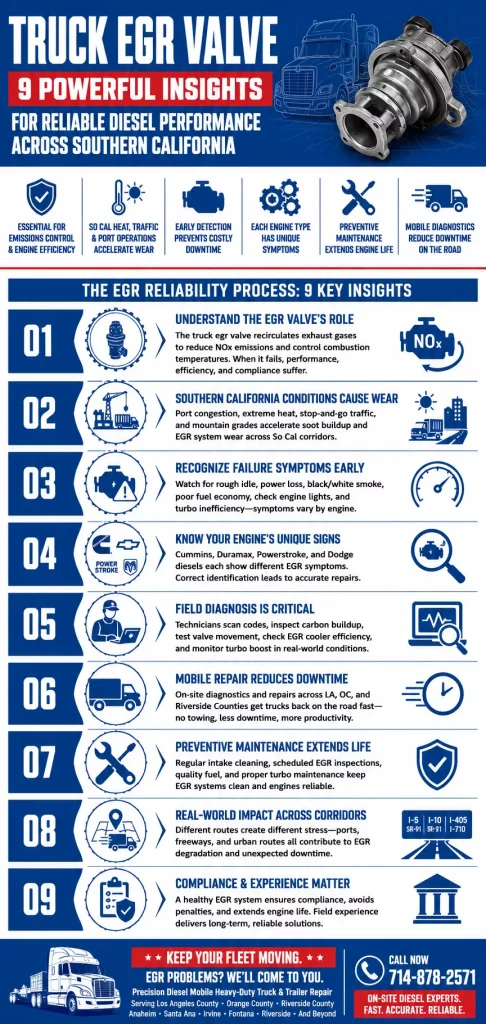
- The truck egr valve is essential for emissions control and engine efficiency
- Southern California traffic, heat, and port operations accelerate EGR wear
- Early detection prevents costly downtime and engine damage
- Cummins, Duramax, Powerstroke, and Dodge engines each show unique symptoms
- Preventive maintenance significantly extends diesel engine life
- Mobile diagnostics reduce downtime across major freight corridors
Precision Diesel Mobile Heavy-Duty Truck and Trailer Repair is a critical support system for drivers and fleet operators who depend on diesel performance every day across Los Angeles County, Orange County, Riverside County, and the broader Southern California logistics network. One of the most overlooked but essential components affecting uptime, emissions compliance, and engine longevity is the truck egr valve.
When a diesel engine starts showing performance issues, reduced fuel efficiency, or unexpected downtime, the root cause often traces back to exhaust gas recirculation problems. Understanding how the truck egr valve works, how it fails, and how it impacts real-world operations across highways like I-5, I-10, I-405, SR-91, and I-710 is essential for keeping commercial vehicles moving.
From port drayage trucks operating near the Port of Los Angeles and Port of Long Beach to distribution fleets running through the Ontario logistics corridor and Inland Empire warehouses, EGR system health directly influences productivity and compliance.
What a Truck EGR Valve Does in Diesel Engines
The truck egr valve plays a central role in controlling nitrogen oxide emissions by recirculating a portion of exhaust gases back into the intake system. This process reduces combustion temperature and helps diesel engines meet environmental regulations set by agencies such as the U.S. Environmental Protection Agency:
https://www.epa.gov/emissions-standards-reference-guide
In practical fleet terms, the EGR system is a balancing act. When functioning correctly, it helps engines operate cleaner. When malfunctioning, it can disrupt airflow, reduce turbo efficiency, and trigger cascading engine issues.
A failing egr valve repair diesel truck can cause:
- Excessive soot buildup in intake systems
- Reduced throttle response
- Increased fuel consumption
- Frequent check engine lights
These issues are especially common in stop-and-go traffic conditions seen in Los Angeles freeways and freight corridors around Commerce, Vernon, and Santa Fe Springs.
How Southern California Operating Conditions Stress EGR Systems
Heavy-duty trucks operating in Southern California face unique environmental and operational stress factors that accelerate EGR wear.
Port and Freight Congestion Zones
Vehicles moving through the Port of Los Angeles and Port of Long Beach experience long idle times during gate queues and container pickup delays. This extended idling increases carbon buildup inside the truck egr valve, reducing airflow efficiency.
Inland Empire Heat Exposure
In cities like Fontana, Riverside, and Ontario, extreme summer temperatures amplify engine heat load. High intake temperatures combined with recirculated exhaust gas create accelerated soot accumulation.
Freeway Stop-and-Go Traffic
Routes such as I-405 through Torrance, Long Beach, and Culver City, as well as the I-710 corridor through Compton and Bellflower, place constant load variation on diesel engines. This inconsistent load pattern contributes to EGR clogging and sticking valves.
Mountain and Grade Stress
Truck routes through Cajon Pass, the Grapevine on I-5, and Ortega Highway add thermal and mechanical strain. Engines working uphill at high load often cycle the EGR system aggressively, increasing wear.
Truck EGR Valve Failure Symptoms Every Diesel Operator Should Recognize
When the truck egr valve begins to fail, the symptoms often appear gradually before turning into serious performance problems. Recognizing these signs early prevents costly downtime.
Cummins Engine Behavior Patterns
In Cummins-powered fleets, common issues include:
- Rough idle during warm-up cycles
- Increased black smoke under acceleration
- Loss of torque during hill climbs in areas like San Dimas or La Verne
The cummins egr valve symptoms often include elevated soot accumulation in intake manifolds and reduced fuel economy over time.
Duramax Engine Indicators
Duramax engines used in light and medium-duty applications frequently show:
- Intermittent power loss
- Cooling system strain during idle
- Hesitation when accelerating on highways like SR-91
The duramax egr valve symptoms typically present alongside clogged EGR coolers and restricted airflow paths.
Powerstroke Diesel Warning Signs
Ford Powerstroke engines often exhibit:
- White or gray exhaust smoke
- Engine knocking under load
- Reduced turbo efficiency when hauling through areas like Anaheim or Irvine
The powerstroke egr valve symptoms are commonly linked to carbon buildup restricting valve movement.
Dodge Diesel EGR Behavior
Ram trucks equipped with Cummins diesel engines also experience:
- Rough shifting under load
- Increased regeneration cycles
- Fuel economy decline in stop-and-go city driving
A faulty dodge diesel egr valve can also lead to frequent limp mode activation during heavy hauling.
Why EGR Failures Are Common in Fleet Operations
Diesel fleets operating across Santa Ana, Garden Grove, Anaheim, and Fullerton often run under tight delivery schedules. These conditions create repeated short-trip cycles that prevent engines from reaching optimal combustion temperatures.
Short-cycle operation leads to:
- Incomplete fuel burn
- Increased particulate matter
- Accelerated soot accumulation in the EGR system
Over time, this directly affects the truck egr valve, reducing airflow efficiency and increasing engine strain.
Field Diagnosis of EGR System Issues in Real-World Conditions
Technicians servicing trucks on-site across Los Angeles County and Orange County often begin diagnosis by analyzing airflow restriction patterns and exhaust temperature irregularities.
A typical field diagnostic process includes:
- Scanning ECM fault codes
- Inspecting intake manifold carbon buildup
- Testing valve movement response
- Checking EGR cooler efficiency
- Monitoring turbo boost consistency
In areas like Santa Monica, Redondo Beach, and Manhattan Beach, coastal humidity combined with urban driving conditions can further complicate diagnosis due to corrosion and sensor degradation.
Mobile Diesel Repair and Its Role in Reducing Downtime
Mobile repair has become essential for fleets operating across large geographic zones such as Los Angeles, Orange, and Riverside Counties. Instead of towing a disabled truck to a shop, on-site diagnostics and repair reduce downtime significantly.
In logistics-heavy zones like:
- City of Industry
- Commerce
- Vernon
- Paramount
- Carson
- Norwalk
- Downey
mobile service allows technicians to address EGR issues directly where failures occur.
A malfunctioning truck egr valve discovered during a roadside breakdown near the I-10 or I-605 corridor can often be diagnosed and repaired without relocating the vehicle, saving hours of lost productivity.
Preventive Maintenance Strategies for EGR Longevity
Preventing EGR failure requires consistent maintenance routines tailored to diesel operating environments.
Key preventive strategies include:
- Regular intake cleaning to reduce carbon buildup
- Scheduled EGR valve inspections every service interval
- Monitoring idle time in port and warehouse zones
- Using high-quality diesel fuel to reduce soot formation
- Ensuring proper turbo system function
Fleet operators working between Irvine Spectrum, South Bay industrial zones, and Inland Empire distribution hubs benefit significantly from structured maintenance programs.
A healthy truck egr valve ensures stable combustion efficiency and reduces long-term engine wear.
Real-World Fleet Impact Across Southern California Corridors
Diesel fleets moving across Anaheim, Santa Ana, Long Beach, and Riverside experience varied operational stress depending on route type.
- Port drayage trucks deal with idle-heavy cycles
- Inland delivery trucks face heat stress and long-haul climbs
- Urban service fleets experience constant stop-and-go wear
Each of these conditions contributes differently to EGR system degradation.
The cumulative effect on the truck egr valve often shows up as reduced engine efficiency, increased emissions violations, and unexpected downtime during peak delivery schedules.
Regulatory Pressure and Compliance Considerations
California emissions regulations are among the strictest in the United States. Trucks operating near residential-adjacent industrial zones such as Huntington Park, South Gate, and Bell Gardens must maintain compliant emissions systems.
A malfunctioning EGR system can lead to:
- Failed roadside inspections
- Compliance penalties
- Forced downtime until repairs are completed
Understanding how the truck egr valve integrates with emissions systems is essential for maintaining operational legality across Southern California freight routes.
Why Field Experience Matters in Diesel EGR Repairs
Diesel systems behave differently under load, temperature variation, and route-specific stress. Experience diagnosing EGR failures in real-world environments such as Cajon Pass climbs or Port of Long Beach congestion is critical.
Technicians working in these environments understand how:
- Heat cycling affects valve movement
- Soot accumulation varies by route
- Turbo behavior interacts with EGR function
This practical understanding is what separates basic repairs from long-term solutions.
Final Service Integration (Natural Placement)
Across Los Angeles County, Orange County, Riverside County, and surrounding Southern California freight corridors, diesel reliability depends on fast and accurate diagnosis of EGR-related failures. When a truck egr valve issue interrupts operations near Long Beach port routes, Inland Empire distribution centers, or congested LA freeways, immediate response becomes critical for minimizing downtime.
Precision Diesel Mobile Heavy-Duty Truck and Trailer Repair supports fleets and operators in these environments with on-site diesel diagnostics and repair services. Assistance is available at 714-878-2571 for trucks operating across Anaheim, Santa Ana, Irvine, Fontana, Riverside, Compton, Carson, Ontario, and every major logistics corridor throughout Southern California.
FAQ: Diesel EGR Systems and Truck Performance
What causes a truck egr valve to fail?
Most failures are caused by soot buildup, extended idling, poor fuel quality, or repeated short-trip driving cycles common in urban Southern California routes.
What are early signs of EGR problems in diesel engines?
Early signs include rough idle, reduced fuel economy, turbo lag, and intermittent check engine lights.
How do cummins egr valve symptoms usually appear?
They typically show as power loss under load, increased exhaust smoke, and carbon buildup in the intake system.
Are duramax egr valve symptoms different from other engines?
Yes, Duramax systems often show cooling inefficiencies and inconsistent throttle response before full failure occurs.
Can a faulty EGR valve damage the engine?
Yes, prolonged issues can lead to turbo strain, intake restriction, and increased engine wear.
How often should a diesel EGR system be inspected?
Most heavy-duty applications benefit from inspection every standard maintenance interval or sooner under heavy-duty cycles.
