

TL;DR
Unplanned mechanical downtime in Southern California costs commercial operators thousands of dollars daily due to missed port windows and tight supply chains. Recognizing early warnings like aftertreatment restrictions, air pressure drops, and thermal stress under heavy grade loads allows you to address failures before they cause total engine shutdown. Accessing fast, professional mobile road service keeps your heavy-duty assets compliant and moving across major regional freight corridors.
Key Takeaways
- Track early signs of diesel particulate filter restriction to avoid severe engine derate modes on critical transit routes.
- Address minor air brake system pressure drops before the tractor-trailer vehicle locks up in heavy freeway traffic.
- Monitor high engine operating temperatures before tackling regional mountain elevations like the Grapevine or Cajon Pass.
- Utilize mobile diesel service units to perform complex diagnostics on-site, completely eliminating expensive heavy-duty towing fees.
When you are hauling a heavy load on the I-5 or sitting in gridlock near the Port of Long Beach, the last thing you want to worry about is an unexpected engine breakdown. Knowing how to locate a trustworthy truck diesel mechanic near me before disaster strikes can mean the difference between keeping your delivery window and losing thousands of dollars in downtime. Southern California freeways place intense physical stress on commercial vehicles, making regular inspection and fast access to field service essential. Our technicians frequently encounter heavy-duty equipment pushed to its absolute limits by stop-and-go congestion and intense seasonal temperatures.
Understanding the precise physical signs of mechanical wear allows fleet operators and owner-operators to make informed decisions long before a dashboard light turns into a full roadside emergency. When components begin to degrade, they leave clear indicators that can be caught during pre-trip inspections or while managing your vehicle in transit. If you notice any of these changing performance metrics, finding an immediate mechanical solution is the smartest way to safeguard your investment.
Mobile Diesel Emergency Service. Southeast Fleet Services
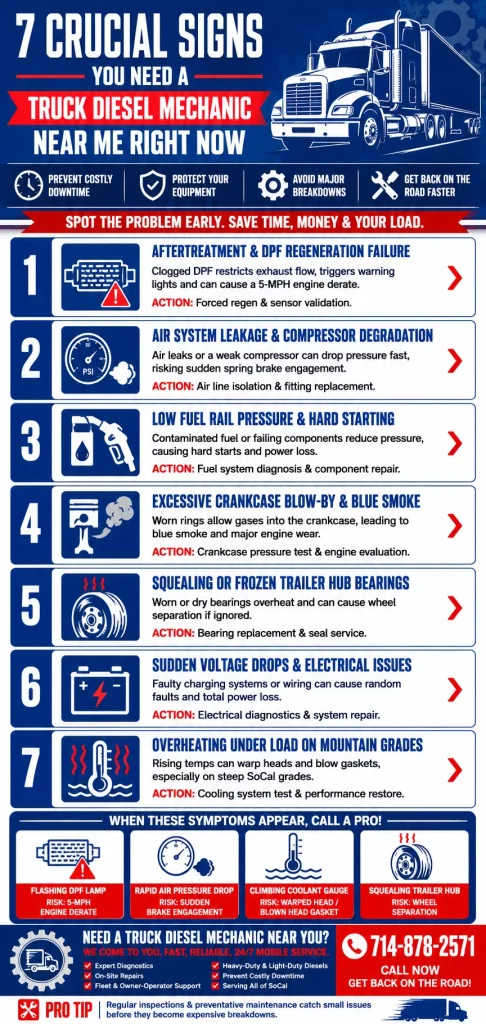
1. Aftertreatment and DPF Regeneration Failure
The diesel particulate filter system remains one of the most common failure points for commercial trucks operating within the industrial zones of South Gate and Vernon. When a vehicle spends hours idling in port queues or crawling through metropolitan traffic, the exhaust system cannot reach the high temperatures required to naturally burn off accumulated soot. Our team typically sees heavy-duty engines experience face-plugging on the particulate filter, which restricts exhaust flow and drastically reduces fuel economy. If your dashboard indicator displays a continuous regeneration request or a flashing aftertreatment light, the vehicle is warning you that a severe power reduction is imminent.
Ignoring these exhaust restrictions eventually forces the engine control module to trigger an engine derate command, reducing your top speed to five miles per hour to prevent internal engine damage. When looking to Find top-rated diesel truck mechanics near me, it is critical to select professionals who carry advanced diagnostic computers capable of executing a forced regeneration in the field. Our technicians routinely service restricted exhaust systems directly on the shoulder or at logistics yards, clearing stubborn fault codes and validating delta pressure sensor readings. Addressing aftertreatment issues early prevents unburned soot from baking onto the fragile substrate, saving you from a costly total filter replacement.
2. Air System Leakage and Compressor Degradation
A heavy-duty truck air system is the lifeblood of both your braking capacity and your trailer suspension stabilization. While operating near busy shipping hubs around Torrance and Carson, your air compressor works constantly to maintain system pressures between 100 and 120 pounds per square inch. If you notice your air pressure gauges taking an unusually long time to recover after applying the service brakes, your compressor may be experiencing internal valve wear or severe carbon buildup. Pneumatic lines are also highly susceptible to dry rotting and cracking due to constant exposure to coastal salt air and high regional ozone levels.
During daily pre-trip inspections, drivers should perform an air brake leakage test by holding the brake pedal down for one minute with the engine off to ensure the pressure drop stays below four pounds per square inch for combination vehicles. If you hear a distinct audible hiss from your glad hands, brake chambers, or inversion valves, finding a diesel truck mechanic near me open now becomes an immediate safety priority. Our mobile repair crews arrive fully stocked with varied air lines, fittings, and replacement governor valves to seal leaks right where they happen. Resolving air delivery faults keeps your spring brakes from suddenly locking up in the middle of a high-speed transit corridor.
3. Low Fuel Rail Pressure and Hard Starting
Modern common-rail diesel engines depend on extreme fuel pressures, often exceeding 30,000 pounds per square inch, to achieve complete fuel atomization and clean combustion. When microscopic contaminants pass through old filters, they quickly scar the internal surfaces of high-pressure fuel pumps and precision fuel injectors. If your truck experiences a hard-start condition in the morning or stumbles noticeably under acceleration near Santa Ana, low fuel rail pressure is often the underlying issue. Our technician will check the return fuel flow rates to pinpoint whether an injector internal seal is leaking fuel back into the return loop.
A drop in fuel delivery pressure quickly starves the cylinders, causing localized lean conditions that raise combustion temperatures and risk cracking a piston crown. If you find yourself hunting for an Affordable diesel engine service for trucks nearby, choosing a team that understands deep fuel system diagnostics is essential. Our mobile service trucks utilize specialized high-pressure gauges and electronic sensor monitoring to isolate failing lift pumps or sticking fuel pressure regulators without guessing. Replacing plugged fuel filters and worn delivery components restores your power band and prevents metal shavings from contaminating the entire fuel architecture.
4. Excessive Crankcase Blow-By and Blue Smoke
As diesel engines accumulate hundreds of thousands of miles, the constant friction wears down the piston rings and cylinder liners, widening the critical tolerances. This physical wear allows high-pressure combustion gases to blow past the rings directly into the engine crankcase, a condition known across the industry as blow-by. You can easily check for this during a routine stop by safely removing the oil filler cap while the engine idles and checking for a heavy, pulsing stream of smoke or direct oil droplets. Heavy crankcase pressure pushes engine oil past turbocharger seals and into the intake tract, resulting in a distinct blue tint in your exhaust gas.
Excessive blow-by is a clear warning sign that structural engine integrity is dropping and that a major mechanical overhaul may be required in the near future. When evaluating Where can I find reputable shops for heavy-duty truck engine repair?, you need a team that looks beyond external symptoms to analyze actual internal engine wear. Our technicians perform precise crankcase pressure tests using water manometers to determine the exact structural condition of your cylinders. Catching high crankcase pressure early allows for scheduled in-frame overhauls at your convenience rather than experiencing a catastrophic engine failure during a run.
5. Squealing or Frozen Trailer Hub Bearings
Trailer maintenance is just as vital as engine care, yet wheel end assemblies are often neglected until they fail completely on paths like the SR-91 or the I-405. Wheel bearings require a constant, clean bath of gear oil or specialized grease to dissipate the massive heat generated by carrying heavy freight loads. If an outer hub cap seal cracks, moisture enters the hub assembly, breaking down the lubricant and causing rapid metal-to-metal pitting on the bearing rollers. Drivers will often hear a faint, high-pitched squeal or notice a distinct burnt-gear-oil smell coming from the trailer wheels during intermediate fuel stops.
Left unchecked, the intense frictional heat can weld the bearing cone directly to the spindle, which can cause the entire dual-wheel assembly to detach from the axle housing while moving. When you need a truck diesel mechanic shop near me capable of handling heavy trailer wheel ends, our mobile response teams are ready to deploy with heavy-duty jacks, replacement seals, and fresh bearing sets. Our technician will clean the spindle, check for heat discoloration, and press in new bearings with the exact specified hub nut torque to ensure long service life. Keeping your trailer hubs cool and sealed prevents dangerous roadside wheel lockups and keeps your trailer rolling smoothly.
6. Sudden Voltage Drops and Electrical Multiplexing Issues
Modern trucks rely on complex multiplexed wiring networks where multiple electronic modules share data continuously over a shared communication bus. High vibrations from rough road surfaces combined with exposure to engine heat can cause wiring harnesses to rub against chassis rails, wearing through the insulation and creating intermittent short circuits. If your dashboard begins flashing random fault codes, or if you notice your voltmeter dropping below 12.6 volts while driving through Anaheim corridors, your electrical charging charging system is failing. Our team typically sees alternator diode failures or corroded battery ground straps cause these confusing electronic gremlins.
A sudden loss of electrical power can shut down the main engine control module instantly, leaving you without steering assist or trailer braking control in heavy traffic. If you need a diesel truck mechanic near me within 5 mi to isolate a complex electrical issue, our mobile diagnostic units can meet you at your current position. Our technicians utilize digital volt-ohm meters and electrical schematic overlays to trace wiring faults back to the exact connector pins. Cleaning corroded ground connections and installing heavy-duty alternators prevents expensive module failures and keeps your electronic logging devices functioning perfectly.
7. Overheating Under Load on Regional Mountain Grades
Tackling major Southern California elevation changes like the steep Grapevine on the I-5 or the long Cajon Pass puts an immense thermal load on a diesel engine cooling system. Your radiator must be completely free of external dirt, road debris, and internal scale buildup to successfully transfer heat away from the engine block. If your water temperature gauge begins climbing past 215 degrees Fahrenheit while pulling a heavy load, your cooling system is failing to keep pace with demand. Our technician will check the operation of your cooling fan clutch to ensure it engages fully when the engine reaches its peak thermal thresholds.
Allowing a diesel engine to overheat can quickly warp cylinder heads, blow head gaskets, and cause the cylinder liners to score the sides of the pistons. When looking for Diesel truck maintenance services close to me before summer temperatures spike in the Inland Empire, proactive cooling system inspections are an absolute necessity. Our teams pressure-test cooling systems to identify hidden hairline cracks in plastic expansion tanks or leaking water pump weep holes. Flushing out old, degraded coolant and replacing sticking thermostats ensures your truck maintains stable operating temperatures, even when pulling max gross vehicle weight up the steepest regional highway grades.
Real-World Scenarios That Require a Truck Diesel Mechanic near me Immediately
| Roadside Symptom | Immediate Operational Risk | Recommended Technician Action |
| Flashing DPF Lamp | Imminent 5-MPH Engine Derate | Forced Regen & Sensor Validation |
| Rapid Air Pressure Drop | Sudden Spring Brake Engagement | Air Line Isolation & Fitting Swap |
| Climbing Coolant Gauge | Warped Cylinder Head / Blown Head | Fan Clutch Test & Radiator Flush |
| Squealing Trailer Hub | Wheel Separation / Axle Spindle | Bearing Replacement & Seal Press |
Operating heavy commercial equipment through major distribution hubs like Fontana means encountering unpredictable mechanical variables every single day. A truck that leaves a warehouse in perfect condition can easily develop a blown turbocharger boot or a ruptured heater hose while sitting in dense freeway gridlock. In these high-stress moments, trying to limp a broken-down vehicle to a distant repair facility can cause extensive collateral damage to internal engine components. Securing professional field assistance right where you stand is the fastest way to stabilize the situation and protect your equipment.Our mobile repair units operate as fully functional shops on wheels, designed specifically to eliminate the logistical headache and high cost of heavy-duty towing services. Whether you are dealing with a disabled box truck near LAX or a semi-truck experiencing fuel delivery issues along the busy I-710 corridor, our technicians bring the repair solution directly to your location. This immediate response protects your cargo, keeps your drivers safe from active highway traffic, and drastically reduces total repair turnaround times.
How to Choose a Reliable Diesel Truck Mechanic
When your equipment is sidelined, making a rushed decision can lead to poor repairs, extended delays, and inflated invoices. Learning how to choose a reliable diesel truck mechanic requires looking closely at a service provider’s diagnostic capabilities, field response times, and component sourcing networks. A high-quality repair team should always be transparent about their diagnostic processes, explaining what fault codes mean and providing clear options before spinning a single wrench. They must also possess dedicated experience across a wide range of medium-duty and heavy-duty platforms, ensuring they understand the unique quirks of your specific engine family.
- Connect Diagnostic Computer to Vehicle ECM
- Isolate Fault Codes & Analyze Live Sensor Data
- Perform Physical System Tests & Visual Check
- Verify Exact Root Cause & Explain Repair Options
- Install Premium OEM Components & Clear Module Codes
To help fleet operators make the best choice during an active roadside breakdown or while scheduling routine fleet care, we have outlined the most critical performance indicators below:
- Advanced Diagnostic Infrastructure: Ensure the mobile service technicians carry up-to-date factory software for major engine lines including Cummins, Detroit Diesel, Paccar, and Volvo. Generic code readers often misinterpret proprietary codes, leading to incorrect parts replacement and wasted field hours.
- On-Site Part Availability: A reliable field mechanic should maintain a robust inventory of critical breakdown parts right on their service truck, including air governors, fuel filters, coolant hoses, turbo boots, and brake chambers.
- Transparent Repair Documentation: Demand clear, itemized breakdowns of all diagnostic findings, labor times, and component costs before work begins. Reputable technicians will gladly walk you through their mechanical reasoning and show you the worn components they are removing.
- Rapid Response and Geo-Familiarity: Choose a repair group that demonstrates an intimate understanding of Southern California logistics routes and port security access requirements. Technicians who know the local terrain can navigate around heavy traffic to reach your stranded vehicle much faster.
Troubleshooting Heavy-Duty Truck Systems and Aftertreatment Problems
The complex aftertreatment networks found on modern heavy-duty trucks require precision calibration and clean chemical inputs to operate within strict environmental compliance frameworks. When the diesel exhaust fluid injection system suffers from crystallization or electrical pump failures, the entire selective catalytic reduction system loses its cleaning efficiency. Our team typically sees low-quality exhaust fluid or failing NOx sensors trigger immediate engine warnings that confuse drivers during interstate runs. Our technicians systematically test fluid quality using refractometers before replacing expensive sensors, ensuring we address the true root cause of your emission system faults.
Emission System Troubleshooting Sequence
- Connect dealer-level diagnostic laptop to truck
- Pull active fault codes and check freeze frame data
- Test DEF quality and concentration levels
- Measure exhaust backpressure across the DPF face
- Replace faulty sensors or command a forced regen
Exhaust gas recirculation valves are also prone to heavy carbon fouling, which can cause them to stick open and introduce too much cooled exhaust back into the engine intake combustion chamber. This condition starves the engine of fresh air, resulting in thick black smoke, poor throttle response, and rapid particulate filter accumulation. When searching for a semi truck diesel mechanic near me to resolve persistent aftertreatment issues, our mobile service teams provide a complete field solution. We carry out detailed circuit tests, clear clogged EGR ports, and replace failed differential pressure sensors on-site, returning your commercial vehicle to full operational status without requiring an expensive shop visit.Maintaining Smaller Commercial Fleets and Light-Duty Diesels
Medium-duty delivery trucks, commercial vans, and work pickups represent the hard-working backbone of service businesses across metropolitan areas like Huntington Beach and Newport Beach. These vehicles face a different set of mechanical challenges than over-the-road trucks, primarily driven by constant short-distance trips and frequent stop-and-start duty cycles. This operating pattern rarely allows light-duty diesel engines to complete natural cleaning cycles, resulting in premature fuel injector fouling and rapid oil dilution. Keeping these smaller commercial assets productive requires a structured preventative maintenance schedule tailored to severe local driving conditions.
If you utilize a fleet of work trucks for contracting, delivery, or mobile service, finding a reliable pickup truck diesel mechanic near me keeps your operations running seamlessly. Smaller diesel powerplants like the Ford Powerstroke, Chevy Duramax, and Ram Cummins systems require specialized diagnostic scanners and specific technical knowledge that general automotive shops simply do not possess. Our team answers this specific market need by providing comprehensive maintenance and mechanical repair options for lighter commercial applications:
- High-Pressure Fuel Injection Repairs: Diagnosing and replacing worn common-rail injectors, high-pressure lines, and fuel pressure regulators to eliminate rough idling and restore lost engine performance.
- Turbocharger Actuator Replacement: Resolving common variable-geometry turbocharger issues, including sticking actuator vanes that cause sudden power loss while entering busy local freeways.
- Suspension and Steering Overhauls: Replacing worn ball joints, tie rods, and steering gearboxes on heavy-duty work trucks to maintain strict roadside safety compliance under full payload conditions.
- Brake System Rebuilding: Installing premium heavy-duty pads, rotors, and calipers designed to handle the intense heat generated by stopping loaded trailers in congested urban traffic corridors.
Whether your company relies on a single delivery truck or a large pool of utility vehicles, having a dedicated mobile diesel pickup truck mechanic near me available to handle field service minimizes disruptions to your daily service schedule. Our fully equipped service trucks can perform complete oil services, fuel system flushes, and sensor updates right at your office, job site, or parking yard.
This completely eliminates the logistical nightmare of driving multiple work trucks to a brick-and-mortar shop and leaving them for several days at a time. Partnering with a versatile service provider ensures that every diesel asset in your fleet, from a class 3 utility pickup to a class 8 tractor, stays mechanically sound and completely ready to work.
Technical Maintenance Milestones for Commercial Diesels
| Service Interval | Critical System Focus | Operational Prevention Value |
| Every 15,000 Miles | Engine Oil & Fuel Filters | Removes Abrasive Contaminants |
| Every 30,000 Miles | Air System Dryer Cartridge | Prevents Water Contamination |
| Every 150,000 Miles | Aftertreatment DPF Clean | Eliminates Ash Accumulation |
| Every 300,000 Miles | Cooling System Flush | Protects Cylinder Liners |
Common Diesel Roadside Questions and Answers
What causes a sudden loss of power accompanied by a loud whistling sound under acceleration?
A sudden drop in engine power paired with a noticeable whistling or rushing air sound almost always points to a rupture in the turbocharger charge air cooler system. This system uses thick rubber boots and solid metal piping to route highly pressurized air from the turbocharger compressor directly into the engine intake manifold. Over time, constant exposure to extreme heat, engine oil mist, and high boost pressures causes these flexible rubber boots to split or blow completely off their metal mounting flanges.
Our technician will check the entire induction tract using a localized pressure test to locate the split, replace the damaged boot with a high-strength silicone component, and secure it with heavy-duty T-bolt clamps to restore full boost pressure.
How often should the air system dryer cartridge be replaced on a heavy-duty truck?
The air dryer cartridge plays a vital role in removing moisture and oil droplets from the air compressed by your engine before it enters the main storage reservoirs. In humid coastal environments like Long Beach and El Segundo, the air dryer cartridge should be replaced at least once every twelve months for standard applications, or every six months for high-utilization local delivery trucks.
When the internal desiccant material becomes completely saturated with water or contaminated with compressor bypass oil, moisture passes directly into your brake valves and suspension components, leading to rapid internal corrosion and unexpected valve sticking. Our team recommends replacing the entire purge valve assembly during this scheduled air system service to ensure your air system exhausts moisture efficiently and remains completely dry.
Why is diesel exhaust fluid quality so important, and what happens if it becomes contaminated?
Modern diesel engines utilize precise selective catalytic reduction systems that inject diesel exhaust fluid, which is a highly specific mixture of 32.5% high-purity urea and 67.5% deionized water, into the hot exhaust stream to break down harmful nitrogen oxides. If water enters your storage tank, or if you use fluid that has degraded from sitting in direct sunlight, the internal NOx sensors will immediately detect a drop in catalyst cleaning efficiency.
The engine control module interprets this as an emissions compliance failure and will quickly initiate an engine power derate to force a mechanical repair. Our technicians carry specialized digital refractometers to test fluid concentration on-site, completely draining contaminated tanks, flushing out the injection lines, and resetting the module codes to get you back on the road safely.
What are the main causes of wheel end oil seal failures on commercial trailers?
Trailer wheel end oil seals are designed to keep vital gear lubricant locked inside the hub assembly while keeping external dirt and road moisture completely locked out. The most frequent cause of seal failure is a plugged hub cap vent plug, which allows internal pressures to build up as the axle heats up during high-speed freeway travel, eventually blowing the rubber seal lip off its sealing seat.
When an oil seal fails, the lubricant coats your brake linings, destroying your stopping power and creating an immediate fire hazard due to the intense friction. Our mobile technicians routinely replace failed wheel seals on the shoulder, thoroughly cleaning the brake shoes, checking the spindle for damage, and installing premium double-lip seals to protect your trailer axles.
Maintaining heavy-duty commercial equipment in prime operational condition requires a dedicated service partner who understands the unique mechanical demands of Southern California logistics infrastructure. Precision Diesel Mobile Heavy-Duty Truck and Trailer Repair provides expert field solutions designed to eliminate expensive equipment transport fees and minimize costly delivery delays. Our team of skilled mobile technicians operates fully equipped service vehicles capable of performing complex computer diagnostics, aftertreatment forced regenerations, air brake system overhauls, and complete trailer wheel end repairs directly at your location. We support owner-operators and commercial fleets across Los Angeles County, Orange County, Riverside County, and all of Southern California, ensuring your drivers stay safe and your assets stay compliant.
Whether you are dealing with a critical emission system fault code near our shops in La Palma or Huntington Beach, or require immediate roadside assistance near El Segundo or Newport Beach, our technicians respond quickly with the exact tools and components needed to fix the problem correctly. We focus on providing transparent mechanical assessments and reliable workmanship that protects your equipment investment over the long haul. Do not let a minor mechanical issue turn into a major logistical breakdown that damages your customer relationships. Contact our dispatch team directly at 714-878-2571 whenever you need an experienced small truck diesel mechanic near me or a heavy-duty field technician ready to deploy to your location.
