
If your pickup truck is slipping out of gear, shifting harshly, or leaking reddish fluid, those are textbook warning signs that something is wrong with your transmission. Knowing what are common signs of transmission problems in a pickup truck early can be the difference between a manageable repair and a catastrophic, wallet-draining replacement.
Key Takeaways
- Slipping gears, delayed engagement, and harsh shifting are the most immediate red flags in any pickup truck transmission.
- Transmission fluid condition and level are the single easiest things you can check yourself before any diagnostic appointment.
- Recent NHTSA investigations cover millions of Ford F-150s and Chevy Silverados, so model-specific awareness matters as much as general symptom knowledge.
- Ignoring early symptoms almost always escalates the repair cost significantly, especially in trucks used for towing or hauling.
- Mobile diesel mechanics can diagnose and address transmission-related issues at your location, saving downtime for fleet operators across Southern California.
- Shuddering, gear hunting, and jerking during acceleration are not normal break-in quirks; they are actionable warning signs requiring prompt attention.
Why Transmission Symptoms in Pickup Trucks Deserve Immediate Attention
Pickup trucks are workhorses. They tow trailers, haul heavy loads, and log tens of thousands of miles in demanding conditions across highways and job sites alike. That workload places enormous stress on the transmission, and when something starts going wrong, the truck rarely gives you a second warning before things get expensive.
The transmission in a modern pickup is a complex piece of engineering. Many current trucks run 8-, 9-, or 10-speed automatic transmissions designed to optimize fuel economy and performance. Unfortunately, that added complexity also means more potential failure points, which is why companies like Precision Diesel Ca focus their expertise on these critical systems. Understanding what to watch for keeps you ahead of the problem.
Slipping Gears and Loss of Driving Power
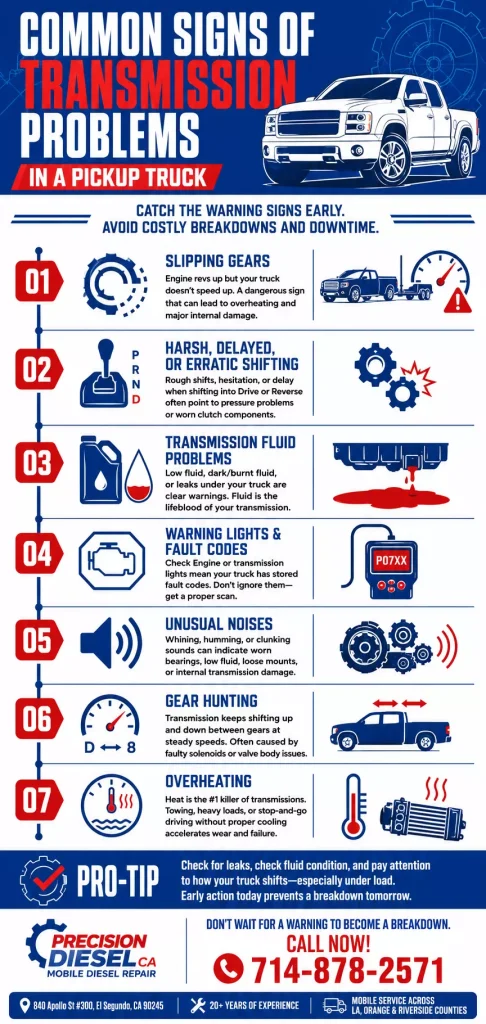
One of the most unsettling sensations you can experience behind the wheel is the feeling that your truck has momentarily lost its connection to the road. Gear slipping happens when the transmission shifts into a gear and then unexpectedly drops out of it, leaving the engine revving without a corresponding increase in vehicle speed.
In a pickup used for towing, this symptom is both dangerous and destructive. The engine compensates by working harder, which generates heat. Transmission overheating accelerates wear on clutch packs, seals, and bands inside the unit. If you notice the tachometer needle climbing without a matching surge in speed, pull over safely and have the system inspected before driving further under load.
Harsh, Delayed, or Erratic Shifting
Normal gear changes in an automatic transmission should be nearly imperceptible. When shifts become rough, thudding, or accompanied by a noticeable jolt, that is a symptom worth taking seriously. Delayed engagement, where the truck hesitates for a second or two after you move the selector from Park to Drive or Reverse, points to internal hydraulic pressure problems or worn clutch material.
This issue has been well-documented in several recent model years. According to NHTSA investigation data reported by Autoblog, over 60% of surveyed owners reported transmission problems in the 2015-2017 Ford F-150 investigation (2026), covering 1,270,970 examples. An additional 43% experienced rear tire lockup events related to transmission defects. That investigation opened in March 2025 and was expanded in 2026, making it one of the most significant transmission-related federal actions in recent memory.
Chevy Silverado and GMC Sierra owners have faced similar experiences. SlashGear’s analysis of trucks with bad transmission problems notes that these models account for nearly 60% of all complaints involving GM’s 10-speed automatic transmissions, according to 2025 data. Shuddering, slipping gears, and jerking during acceleration or towing are the most commonly reported symptoms from Silverado and Sierra owners.
Transmission Fluid Problems: Color, Smell, and Leaks
Transmission fluid is the lifeblood of the entire system. Healthy fluid is typically bright red and slightly sweet-smelling. When you notice dark brown or black fluid, a burnt odor, or a puddle forming beneath the truck where the transmission sits, those are unmistakable signs of a problem developing.
Checking your transmission fluid is one of the few diagnostic steps most truck owners can perform without tools. Pull the dipstick (if your truck has one; many newer models require a professional scan), wipe it clean, reinsert it, and check both the level and the color. Low fluid often indicates a leak somewhere in the system, either at a seal, gasket, or cooler line. Burnt fluid means the fluid has been overheated and has lost its lubricating and hydraulic properties.
Neglecting fluid maintenance is widely cited by transmission specialists as one of the primary contributors to early failure. For trucks operating in stop-and-go traffic or towing regularly, service intervals should be more frequent than the standard schedule in your owner’s manual. For reference, the Mayo Clinic’s approach to preventive care draws a parallel that resonates here: early, proactive maintenance prevents far more serious problems than reactive treatment ever can.
Warning Lights and Electronic Fault Codes
Modern pickups use a network of sensors that monitor transmission behavior in real time. When the transmission control module detects an anomaly, it typically triggers the Check Engine light or a dedicated transmission warning indicator on the dashboard. Many drivers dismiss these lights as minor issues, especially if the truck still seems to drive normally in the short term. That is a costly mistake.
Fault codes stored in the transmission control module can pinpoint whether the problem is a sensor, solenoid, valve body, or something mechanical inside the unit. A proper diagnostic scan is essential before any repair decision is made. According to pickuptrucktalk.com’s coverage of known F-150 problems, harsh shifting and hesitation in Ford F-150 10-speed transmissions occur especially under load, and these symptoms often generate specific fault codes that guide the repair process.
You can browse articles covering related diesel maintenance topics to stay informed about what different warning lights and fault codes can mean for your specific truck.
Unusual Noises: Whining, Clunking, and Humming
Your truck communicates a lot through sound. A healthy transmission operates quietly in the background. Whining or humming noises that change pitch with vehicle speed can indicate worn bearings, low fluid, or a failing torque converter. A clunking sound during gear changes often points to worn U-joints, loose mounts, or internal transmission damage.
One useful way to isolate transmission noise from driveline noise is to observe when it occurs. Noise that appears only during gear shifts, particularly at highway speeds or under heavy throttle, is more likely transmission-related. Noise that is constant and changes with speed may point toward wheel bearings or the driveshaft instead. Either way, neither symptom should be ignored in a truck that hauls loads or tows trailers regularly.
Gear Hunting and Inability to Hold a Gear
Gear hunting is the term used when a transmission repeatedly shifts up and down between two gears without settling. You may feel this as a constant back-and-forth lurch at steady highway speeds. It can happen due to faulty shift solenoids, a worn valve body, or incorrect programming in the transmission control module.
This symptom has been specifically noted in Toyota Tundra models. According to NHTSA recall 24V-125 as reported by pickuptrucktalk.com on the Toyota Tacoma, Toyota recalled 280,663 pickup trucks and SUVs in February 2024 for transmission control issues affecting the Tundra platform. The J.D. Power 2025 ratings show the Tundra receiving 83 out of 100 for Quality and Reliability, an improvement, but one that followed a period of significant transmission-related owner frustration.
The Nissan Frontier has fared relatively better in recent years. According to pickuptrucktalk.com’s analysis of Frontier known problems, transmission complaints numbered in the hundreds against 65,232 annual sales in 2025, indicating a lower relative incidence rate compared to domestic competitors.
The Role of Towing and Payload in Accelerating Transmission Wear
Pickup trucks are rated for specific towing and payload capacities for good reason. Consistently exceeding those limits or even pushing close to them without proper transmission service accelerates wear dramatically. The heat generated during heavy towing is the primary enemy of transmission longevity.
Transmission coolers, either stock or aftermarket, are one of the most effective tools for extending transmission life in trucks used for commercial or recreational towing. Trucks that operate commercially, whether on construction sites, in delivery fleets, or for agricultural work, should be on a preventive maintenance schedule that accounts for actual usage load rather than simple mileage.
Fleet operators in Southern California should review careers opportunities in the diesel service industry while also ensuring they understand the proper dpf cleaning services needed for emissions compliance.
Understanding the relationship between load and wear also connects to emissions compliance. Transmission problems that reduce fuel efficiency can indirectly affect a truck’s emissions performance. Precision Diesel’s approach serves as a reminder that the entire drivetrain, including the transmission, works as a connected system where one failing component affects others.
Model-Specific Awareness and Why It Matters
Not every transmission problem is created equal, and the truck you drive matters when interpreting symptoms. The service approach at Precision Diesel reflects this reality: technicians familiar with specific truck platforms diagnose issues faster and more accurately than general-purpose shops.
If you drive a Ford F-150 from the 2015 to 2017 model years, the NHTSA investigation is directly relevant to your vehicle. If you operate a Chevy Silverado HD from the 2024-2026 model years, the ongoing investigation into valve-body failures and complete transmission replacements, as reported by Consumer Reports in 2024, is something your fleet manager should be tracking. The Silverado’s J.D. Power 2025 Quality and Reliability score of 86 out of 100 reflects improvement, but recent model-year investigations show that problems can still emerge even in highly rated trucks.
For more information about what’s available in Southern California’s mobile diesel repair sector, you can learn about about Precision Diesel’s 20-plus years of experience in the industry.
For context on how federal vehicle safety investigations work and why NHTSA involvement matters for truck owners, the NHTSA vehicle safety resources at NHTSA.gov provide complaint filing tools and open investigation status for any registered vehicle owner in the United States.
Spotting Transmission Trouble Before It Becomes a Breakdown
The most effective approach to what are common signs of transmission problems in a pickup truck is to combine visual checks, behavioral observation, and scheduled diagnostics into a consistent habit. Watch for fluid leaks under the truck after it sits overnight. Pay attention to how the truck shifts during the first five minutes of driving, when fluid pressure is stabilizing. Note whether the transmission behaves differently when the engine is fully warmed up versus cold.
NIH research on occupational health for commercial drivers highlights that vehicle reliability directly affects driver safety and stress levels, reinforcing why transmission awareness is not just a mechanical concern but a safety priority for anyone operating a commercial pickup.
For fleet operators managing multiple vehicles across Los Angeles County, Orange County, or Riverside County, a structured inspection cadence that includes transmission fluid checks, electronic fault code scans, and visual leak inspections is the most cost-effective way to keep trucks on the road. It’s important to consult privacy policy information when contracting with service providers for fleet maintenance documentation.
Things to Know
- Transmission fluid should be checked not just for level but also for color and smell. Dark, burnt-smelling fluid is a warning sign even if the level reads correctly on the dipstick.
- Many modern pickup trucks, including recent Ford F-150 and Ram 1500 models, use sealed transmissions with no dipstick. Checking fluid on these requires a lift and professional equipment, making scheduled shop visits non-negotiable.
- A single harsh shift does not always mean the transmission is failing. Cold weather can temporarily thicken transmission fluid and cause rough engagement for the first few minutes of driving. The concern is when the symptom persists after the truck reaches normal operating temperature.
- NHTSA allows any registered vehicle owner in the United States to file a complaint and check open investigations at no cost at NHTSA.gov. If your truck falls under an active investigation, that documentation can support a warranty or goodwill repair claim with the manufacturer.
- Transmission problems can sometimes mimic driveline or engine issues and vice versa. A shudder felt at highway speed could be a transmission torque converter, a worn U-joint, or an unbalanced driveshaft. A proper electronic diagnostic scan is the only reliable way to separate these causes before spending money on parts.
- Towing near or at your truck’s maximum rated capacity without an aftermarket transmission cooler dramatically shortens fluid life and accelerates internal wear, even if the truck otherwise feels fine.
Let Precision Diesel Catch Transmission Problems Before They Catch You
If you are noticing any of the symptoms covered above, every mile you delay is a mile closer to a full transmission replacement. Precision Diesel’s mobile diesel mechanics serve fleet operators and commercial truck owners across Los Angeles County, Orange County, Riverside County, and surrounding areas in Southern California, bringing diagnostics and repair directly to your yard, job site, or roadside location.
With over 20 years of hands-on experience in heavy-duty diesel truck repair, the Precision Diesel team performs engine computer diagnostics, transmission-related inspections, and full preventive maintenance services without requiring you to take your truck out of service for days at a time. Call (714) 878-2571 right now to schedule a mobile diagnostic visit and get a clear answer on what your transmission is telling you before a warning sign becomes a breakdown.
Frequently Asked Questions
How to tell if your truck transmission is bad?
The clearest indicators are slipping gears, delayed engagement when shifting into Drive or Reverse, harsh or erratic gear changes, and visible transmission fluid leaks beneath the truck.
Pay close attention to how the truck behaves during the first few minutes of driving and under load, such as when merging onto a highway or starting a tow. If the Check Engine light is on alongside any of these symptoms, a fault code scan should be your immediate next step. A transmission that is genuinely failing will typically show multiple symptoms together rather than just one in isolation.
Is it worth fixing a transmission problem?
Whether a transmission repair is worth the cost depends on the truck’s overall condition, mileage, remaining useful life, and the nature of the specific failure.
A solenoid replacement or fluid flush on a truck with 80,000 miles and a solid maintenance history is almost always worth completing. A full rebuild or replacement on a high-mileage truck with other deferred maintenance items requires a more careful cost-benefit analysis. For commercial fleet vehicles, the calculation also includes downtime costs and the expense of sourcing a replacement unit. Getting a detailed diagnostic report before authorizing any major repair gives you the information you need to make that call with confidence.
What is the number one killer of transmissions?
Heat is the single greatest cause of premature transmission failure, and it is almost always the result of low fluid, degraded fluid, or sustained operation beyond the transmission’s rated load capacity.
When transmission fluid breaks down from overheating, it loses its ability to lubricate moving parts and maintain the hydraulic pressure needed for clean gear changes. This creates a cycle where heat causes wear, wear creates more heat, and the damage compounds quickly. Trucks used for towing, hauling, or stop-and-go commercial driving are especially vulnerable. Regular fluid changes and, where appropriate, an aftermarket transmission cooler are the most direct countermeasures available to any truck owner.
Which truck has the worst transmission problems?
Based on current NHTSA investigation data and owner complaint volumes, the Ford F-150 equipped with the 10-speed automatic transmission from the 2015 to 2017 model years has drawn the most significant federal scrutiny in recent years.
According to an NHTSA investigation expanded in 2026 and reported by Autoblog, over 60% of surveyed owners in that investigation reported transmission problems across a pool of nearly 1.3 million affected vehicles, with 43% experiencing rear tire lockup events linked to transmission defects. Chevy Silverado and GMC Sierra trucks also rank high in complaint volume, accounting for nearly 60% of all complaints involving GM’s 10-speed automatic, according to 2025 data. Toyota addressed its own issues with a February 2024 recall covering 280,663 Tundra and related vehicles for transmission control problems under NHTSA recall 24V-125.
What Are the Signs of Truck Transmission Problems?
The most recognizable signs include gear slipping, harsh or delayed shifting, shuddering during acceleration, whining or clunking noises, burnt-smelling fluid, fluid leaks, and an illuminated Check Engine or transmission warning light.
In pickup trucks specifically, these symptoms often become more pronounced under towing or payload conditions because the transmission is working harder and generating more heat. Gear hunting, where the transmission repeatedly shifts between two gears at steady highway speeds, is another symptom that points to valve body or solenoid issues. Any combination of two or more of these signs appearing together should be treated as an urgent diagnostic priority, not something to monitor for a few more weeks.
The Bottom Line on What Are Common Signs of Transmission Problems in a Pickup Truck
Transmission symptoms rarely stay mild for long, especially in trucks that work hard day after day. Slipping gears, rough shifts, fluid leaks, warning lights, and unusual noises are your truck’s way of asking for help before the situation becomes irreversible. Acting on those signals early is almost always cheaper, faster, and safer than waiting until the truck stops moving.
If you operate a commercial fleet or a heavy-duty pickup in Southern California, connect with Precision Diesel at (714) 878-2571 or visit their truck repair shop at 840 Apollo St #300, El Segundo, CA 90245. Their expert mobile diesel team covers Los Angeles County, Orange County, Riverside County, and surrounding areas, and they will come to you so your truck stays productive while the problem gets solved.
