

Signs your diesel turbo is failing typically include a combination of power loss, unusual exhaust smoke, strange noises, and worsening fuel economy. Catching these warning signs early can save you thousands of dollars in repairs and keep your truck compliant, safe, and on the road.
Learning to spot the top signs your diesel turbo is failing gives you the ability to address minor wear before it causes major engine damage.
Key Takeaways
- Excessive black, blue, or white smoke from the exhaust is one of the earliest and most reliable indicators of turbo trouble.
- A whining, whistling, or grinding noise from the turbo area should never be ignored, as it often signals bearing failure or compressor wheel damage.
- Noticeable power loss under load, especially at highway speeds or on grades, points directly to reduced turbo boost pressure.
- Turbo failure can cause a significant drop in fuel economy, often 10-20% worse than baseline.
- Oil leaks around the turbo housing are a common symptom that frequently goes unnoticed until serious damage has already occurred.
- Getting a mobile diesel technician on-site early is almost always cheaper than waiting for a complete turbo failure or engine damage.
Why the Turbocharger Is the Heart of Your Diesel Engine
Your diesel engine’s turbocharger forces compressed air into the combustion chamber, allowing the engine to burn more fuel and generate significantly more power than it could naturally aspirate on its own. On a Class 8 semi truck or heavy-duty commercial vehicle, the turbo is not a luxury item. It is a core component that directly affects horsepower, torque, emissions output, and fuel efficiency. Because this component is so critical to engine health, recognizing the early signs your diesel turbo is failing should be a routine priority for every driver.
According to the U.S. Department of Energy, diesel-powered vehicles account for a large share of commercial freight movement in the United States, and turbocharging is central to modern diesel efficiency standards. When that turbo starts to degrade, every part of the engine’s performance suffers.
For fleet operators running routes across Los Angeles County, Orange County, or Riverside County, a failing turbo can mean missed deliveries, failed DOT inspections, and costly roadside breakdowns. Understanding the signs your diesel turbo is failing is not just mechanical knowledge. It is essential fleet management.
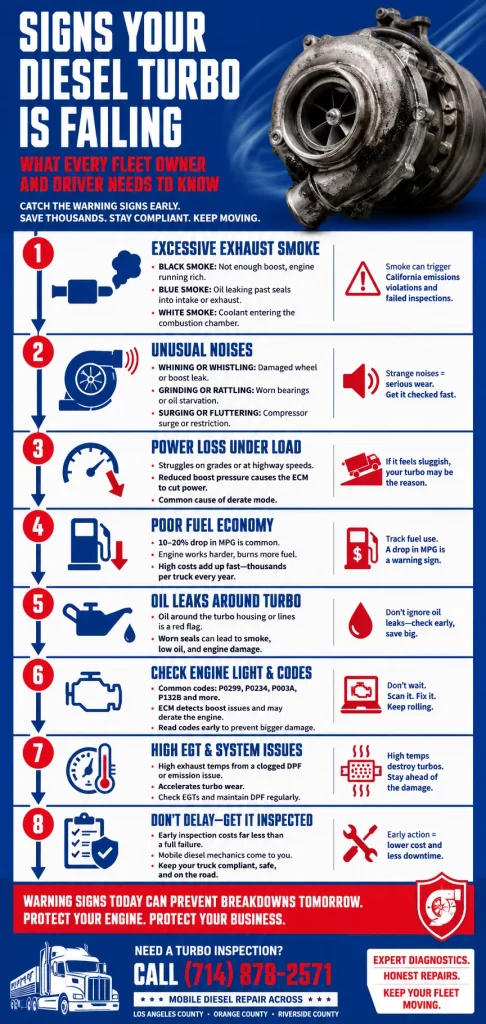
The Most Visible Warning Signs: Exhaust Smoke Color Tells the Story
One of the fastest ways to diagnose a turbo problem is to pay close attention to what is coming out of your exhaust pipe. Different smoke colors indicate different failure modes.
Black Smoke
Black smoke usually means the engine is running rich, burning more fuel than the air supply can support. A failing turbo that cannot deliver adequate boost pressure will cause exactly this imbalance. If your truck is producing thick black smoke under load, the turbo’s compressor side may be underperforming.
Blue Smoke
Blue or blue-gray smoke is a strong indicator that engine oil is being burned in the combustion chamber. This happens when turbo seals fail and oil leaks past the bearing housing into the intake or exhaust stream. Left unchecked, this leads to catalytic converter damage, excessive oil consumption, and potentially catastrophic engine failure. Blue exhaust smoke is among the most urgent visual signs your diesel turbo is failing and needs immediate mechanical attention.
White Smoke
White smoke can indicate coolant entering the combustion chamber, which sometimes ties back to a cracked turbo housing or a failed oil cooler adjacent to the turbocharger.
Fleet operators in California should also be aware that visible smoke emissions can trigger california truck emissions compliance issues. California’s Air Resources Board (CARB) has strict opacity standards for diesel exhaust, and a visibly smoking truck can result in fines or being pulled off the road during a roadside inspection.
Things to Know
- Turbocharger failure is one of the top causes of unplanned diesel truck breakdowns, with repair costs ranging from $1,500 to over $4,500 depending on the engine platform. Early detection is key; catching the signs your diesel turbo is failing before total lockup can save thousands in labor and replacement costs.
- Most turbo failures are directly linked to oil starvation or oil contamination, both of which are preventable through scheduled maintenance.
- A “lazy” turbo that spools up slowly can be just as damaging over time as one that has already failed completely.
- High exhaust gas temperatures (EGT) caused by a partially blocked DPF can accelerate turbo wear significantly.
- Always check your heavy truck insurance maintenance documentation before authorizing repairs, as some policies have requirements around pre-approved service providers and documented maintenance histories.
- Turbo failures on diesel engines are not always sudden. Many develop over hundreds of hours of operation before reaching a critical failure point.
Noises You Should Never Ignore
Sound is one of the most reliable diagnostic tools available to a driver. Your turbocharger operates at extremely high RPMs, sometimes exceeding 150,000 RPM on a heavy-duty diesel application, according to Bosch Automotive. At those speeds, even minor imbalances or wear produce very distinct sounds.
Paying close attention to these acoustic changes is one of the quickest ways to detect the early signs your diesel turbo is failing.
Whining or High-Pitched Whistling
A high-pitched whine that increases with engine RPM often means the compressor wheel or turbine wheel is damaged or out of balance. It can also point to a boost pressure leak in the intake piping, which forces the turbo to work harder to compensate.
Grinding or Rattling
A metallic grinding noise, especially at idle or during spool-up, strongly suggests the turbo’s bearings are failing. Bearing failure is often the end-stage result of oil starvation or contaminated oil running through the system.
Surging or Fluttering Sound
A fluttering or “chuffing” sound under boost is commonly called compressor surge. It happens when airflow reverses through the compressor due to a downstream restriction or wastegate malfunction.
Any of these sounds warrant an immediate inspection by a qualified diesel mechanic. Waiting even a few days after hearing bearing noise can turn a $1,500 turbo replacement into a $6,000 or more engine repair if contaminated oil or debris reaches the engine internals.
Power Loss, Boost Pressure, and What the Numbers Mean
If your truck feels sluggish under load, struggles on grades it used to handle easily, or cannot reach its normal top speed, reduced turbo boost is almost certainly a factor. Your engine management system relies on the turbocharger delivering a target boost pressure. When actual boost falls short of target, the ECM will typically derate engine output to protect internal components.
According to the National Institute for Automotive Service Excellence (ASE), boost pressure faults are among the most frequently diagnosed turbo-related trouble codes on diesel platforms. A boost pressure sensor reading below spec, combined with driver-reported power loss, almost always confirms the turbo is struggling.
For fleet managers using commercial vehicle gps fleet tracking, a sudden and consistent drop in average speed on familiar routes can actually be an early indicator of power loss related to turbo degradation. Tracking systems that log speed, engine load, and route time can flag these anomalies before the driver even reports a problem.
Fuel Economy Decline: The Hidden Cost of a Failing Turbo
A turbocharger that is not performing at spec forces the engine to work harder to produce the same output. The practical result is that fuel consumption increases noticeably. An unexplained drop in miles per gallon is often one of the subtle financial signs your diesel turbo is failing long before a code appears. For a commercial truck logging 100,000 miles per year at diesel prices averaging $3.80 to $4.50 per gallon in Southern California, even a 10% drop in fuel economy adds up to thousands of dollars annually per vehicle.
The U.S. Energy Information Administration tracks diesel fuel prices nationally, and California consistently ranks among the highest-cost states for diesel. A degraded turbo on a vehicle that runs Los Angeles to San Diego routes daily is not just a mechanical inconvenience. It is a direct hit to operating margins.
Fleet operators who notice unexplained fuel cost increases should cross-reference maintenance records with current turbo performance data. A skilled team of commercial truck mechanics can run a full boost pressure test, inspect the intercooler for leaks, and check turbo shaft play within a single on-site visit, without pulling the truck off its route for an extended shop stay.
Check Engine Lights, Fault Codes, and Diagnostics
Modern diesel trucks store fault codes that correspond directly to turbocharger subsystems. Common turbo-related codes include:
- P0299: Turbo/Supercharger Underboost Condition
- P0234: Turbocharger Overboost Condition
- P003A: Turbocharger Boost Control Position Not Learned
- P132B and related codes: Turbo actuator circuit faults (common on Cummins and Detroit platforms)
A check engine light illuminated alongside any of these codes confirms that the ECM has detected a turbocharger performance fault. When paired with performance issues, these fault codes act as clear digital indicators of the signs your diesel turbo is failing. However, many fleet operators miss the window between when a fault code is first stored and when it becomes a drivability issue. By the time the light is on and power loss is noticeable, damage may already be compounding.
Reading fault codes requires a professional-grade scanner capable of accessing engine-specific parameters. Precision Diesel’s mobile service units, serving Los Angeles County, Orange County, Riverside County, and surrounding areas, carry the diagnostic tools needed to pull and interpret these codes on-site. You can reach their team at (714) 878-2571 for emergency support.
For additional reading on turbocharger diagnostics and maintenance procedures, check out the articles published by Precision Diesel, which cover a wide range of heavy-duty diesel topics relevant to California fleet operators.
The Mayo Clinic model of systematic diagnosis is often cited in fleet maintenance training as an analogy: treat symptoms as clues, not diagnoses. A check engine light is the symptom. The root cause may be the turbo itself, or it may be an upstream or downstream issue affecting turbo performance.
Ready to Get Your Turbo Inspected Before It Fails Completely?
If any of the symptoms in this article sound familiar, the single best step you can take right now is to schedule a mobile diagnostic inspection. Do not wait for a roadside breakdown or a failed DOT inspection to force your hand. Precision Diesel operates across Southern California and brings shop-level diagnostics directly to your yard or job site. Call (714) 878-2571 today or visit their website to request service. Catching a failing turbo at the symptom stage versus at the failure stage is the difference between a $1,500 repair and a $6,000-plus engine rebuild.
Frequently Asked Questions
What Are the Common Signs of Turbocharger Failure?
The most common signs include excessive exhaust smoke, noticeable power loss under load, unusual whining or grinding noises, increased fuel consumption, and illuminated fault codes related to boost pressure.
These symptoms often appear gradually rather than all at once, which is why regular preventive maintenance is so important for catching turbo degradation early. On commercial diesel trucks, even mild underboost can affect hauling capacity and fuel economy significantly before triggering a check engine light.
Why Am I Seeing Excessive Smoke from My Exhaust?
Excessive exhaust smoke, particularly blue or black smoke, is a direct indicator that the turbocharger is not functioning correctly and may be allowing oil or fuel imbalances into the combustion cycle.
Blue smoke specifically points to oil seal failure within the turbo, while black smoke suggests insufficient boost pressure causing a rich fuel condition. Both require immediate inspection, especially in California where visible smoke emissions can lead to CARB compliance violations.
What Does a Whining or Whistling Noise from the Turbo Mean?
A whining or whistling noise from the turbo area typically signals a damaged compressor wheel, a boost pressure leak in the intake piping, or the early stages of bearing failure.
These sounds tend to intensify with engine RPM and under load. A persistent high-pitched whine that was not present previously should be treated as an urgent diagnostic priority, not a noise to monitor over several weeks.
Can Turbo Failure Affect Fuel Economy?
Yes, a failing turbocharger directly reduces fuel efficiency because the engine must consume more fuel to compensate for reduced boost pressure and combustion efficiency.
For high-mileage commercial trucks in California, where diesel prices frequently exceed $4.00 per gallon, the cumulative cost of a degraded turbo operating for weeks or months can easily outpace the cost of a timely repair. Fleet operators should treat a sudden drop in miles per gallon as a diagnostic trigger.
What Does the Check Engine Light Indicate Regarding the Turbo?
A check engine light paired with a P0299 or similar boost pressure fault code is a strong signal that the turbocharger is operating outside its designed pressure parameters.
Modern diesel ECMs monitor turbo boost in real time and will store fault codes as soon as deviations occur. Some codes will also trigger engine derating, which limits power output to prevent further damage. Getting a qualified technician to read and interpret these codes as soon as the light appears is the fastest way to determine whether a repair is urgent.
The Bottom Line on Signs Your Diesel Turbo Is Failing
Recognizing the signs your diesel turbo is failing early is the single most cost-effective thing a fleet owner or driver can do to protect a high-value asset. Smoke, noise, power loss, and fault codes are not problems that improve with time or distance. They escalate. Ignoring the clear signs your diesel turbo is failing almost always leads to higher fuel bills and catastrophic component damage.
Precision Diesel’s mobile team across Southern California is built specifically to address these situations where you need them most: at your yard, at your job site, or at the side of the road. Do not let a warning sign become an emergency. Call (714) 878-2571 or request service online to keep your fleet moving.
