

Common issues fixed by mobile diesel repair cover a wide range of mechanical, electrical, and safety-critical problems directly at your truck’s location, eliminating tow costs and cutting downtime to a fraction of what a shop visit requires. From dead-start fuel system failures to DPF regeneration faults, trained mobile technicians handle most of the breakdowns that sideline commercial trucks every day.
Key Takeaways
- Fuel system problems account for roughly 30% of all diesel engine failures, and most can be diagnosed and addressed on-site without a tow
- Engine overheating, brake air leaks, and electrical faults are among the most dangerous issues mobile mechanics resolve roadside
- Downtime costs for commercial fleets routinely exceed the repair cost itself, making fast on-site response a direct financial advantage
- Turbocharger and transmission problems are more complex but can often be assessed and partially repaired on-site before a shop transfer becomes necessary
- Preventative maintenance scheduled through a mobile provider dramatically reduces the frequency of emergency breakdowns
- Precision Diesel serves Los Angeles County, Orange County, Riverside County, and surrounding areas with over 20 years of heavy-duty diesel experience
Understanding the Range of Common Issues Fixed by Mobile Diesel Repair
Fleet managers often wonder what types of roadside emergencies a mobile unit can clear without a tow. The short answer is that the vast majority of daily mechanical failures fall within the scope of rapid roadside assistance. When you look closely at common issues fixed by mobile diesel repair, you find that technicians carry specialized scan tools, common replacement parts, and fluid transfer equipment designed to address severe mechanical failures right where your truck pulled over.
What Mobile Mechanics Actually Fix: A Breakdown of the Most Common Problems
Understanding the common issues fixed by mobile diesel repair helps fleet managers and owner-operators make smarter decisions when a truck goes down. The list is longer than most people expect.
Fuel System and No-Start Conditions
A diesel truck that won’t turn over costs you money by the minute. Fuel system failures are the number one cause of unexpected diesel breakdowns, accounting for approximately 30% of all diesel engine failures according to the Diesel Technology Forum. The culprits typically include worn glow plugs, clogged fuel filters, failed injectors, or contaminated fuel.
Mobile mechanics carry diagnostic scan tools capable of reading live injector data and fuel rail pressure, allowing them to pinpoint the root cause without guessing. Fuel filter replacements, glow plug swaps, and injector cleaning are all performed on-site. Knowing how often to change diesel oil and keeping fuel filters on schedule is one of the simplest ways to avoid no-start scenarios altogether.
Engine Overheating and Cooling System Failures
Overheating is a shutdown event that can escalate into catastrophic engine damage within minutes if ignored. The most common causes are a failed water pump, a plugged radiator, a seized fan clutch, or collapsed coolant hoses. Mobile technicians carry thermostats, hoses, and coolant to perform repairs immediately.
A cooling system failure on the I-710 freight corridor near Long Beach, for example, does not require a tow to a shop in Santa Ana. A mobile unit from Precision Diesel can reach that truck, run a pressure test on the cooling system, and replace the failed component on the shoulder. The NIH’s transportation health data underscores how heat-related mechanical failures are more prevalent in warm-climate regions, which makes Southern California fleets particularly vulnerable during summer months.
Power Loss, Fuel Efficiency Drops, and Turbocharger Issues
Sudden power loss or a noticeable drop in fuel economy usually points to a restricted air intake, failing fuel injectors, a clogged DPF, or a turbocharger problem. Mobile mechanics clean or replace injectors, swap air filters, and perform forced DPF regenerations on-site.
Turbochargers are more complex. A mobile technician can diagnose shaft play, check boost pressure, and inspect intercooler piping to determine whether the issue is a boost leak, a failed actuator, or a worn cartridge. Minor turbo-related repairs, including actuator replacements and intercooler hose fixes, are handled roadside. Full cartridge replacements typically require a shop but the mobile diagnostic step saves time by confirming the exact part needed before the truck is moved.
Fleet dispatchers who familiarize themselves with common issues fixed by mobile diesel repair can save thousands of dollars each year on unnecessary towing fees. For safety context around fuel handling during these repairs, reviewing is diesel fuel flammable how to handle diesel fuel gives technicians and drivers important handling guidance.
Brake System Failures and Air System Problems
Brake issues are the most safety-critical problems on this list. Even a small air leak in the brake system can cause enough pressure drop to trigger a warning light or, worse, result in a safety inspection failure at a weigh station. Driving a heavy duty truck with air brakes requires a solid understanding of how air pressure interacts with braking performance, and that knowledge informs how quickly a driver should call for help when a brake fault appears.
Mobile technicians carry slack adjusters, air dryer cartridges, glad hands, brake chambers, and ABS diagnostic tools. Precision Diesel stocks components from Group 31 batteries to glad hands and airlines, meaning brake-related roadside repairs rarely require a parts run. ABS faults on semi-trailers are a frequent call-out item, and learning about 3 common issues with semi trailer abs modules and how we fix them illustrates exactly the kind of electrical-meets-safety problem that mobile repair handles efficiently.
Electrical Faults, Check Engine Lights, and Emissions System Problems
Electrical diagnostics are often skipped or delayed because fleet managers assume they require a dealer-level shop. That assumption is wrong. Mobile mechanics equipped with J1939/J1708 diagnostic interfaces can pull fault codes, test circuits, and repair wiring harness issues on-site. Heavy-duty fleet operators rely on fast response times to resolve the common issues fixed by mobile diesel repair, ensuring that minor mechanical faults do not lead to long delays.
Emissions system problems are increasingly common, especially given California’s strict regulations. Mobile technicians perform forced DPF regenerations, clean DEF lines, replace crystallized DEF injectors, and reset emissions-related fault codes. Understanding what is the california diesel engine ban and its effects is critical for Southern California fleet operators who need to stay compliant while keeping trucks running.
Transmission Diagnostics and On-Site Assessment
Transmission problems are among the most complex issues a diesel truck faces. A full rebuild is beyond roadside scope, but mobile technicians play a critical role in transmission-related calls. They can diagnose fault codes, check fluid levels and condition, inspect linkages and shift solenoids, and identify whether the problem is electrical or mechanical.
In many cases, a transmission fault code triggered by a failed sensor or low fluid can be resolved on-site, getting the truck moving without a tow. When a more serious repair is needed, the mobile technician’s on-site assessment ensures the truck goes directly to the right shop with a confirmed diagnosis, eliminating redundant diagnostic fees. The Federal Motor Carrier Safety Administration (FMCSA) mandates that commercial vehicles with mechanical defects must be taken out of service, which makes fast, accurate mobile diagnosis a compliance issue, not just a convenience.
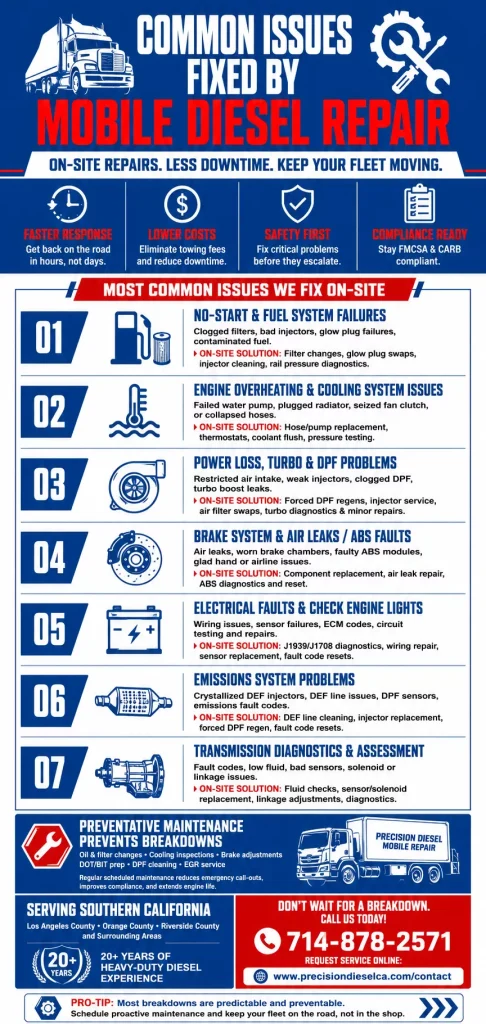
Common Issues Comparison Table
| Problem Type | Common Cause | On-Site Resolution | Typical Outcome |
|---|---|---|---|
| No-Start / Fuel System | Clogged filter, bad injector, glow plug failure | Full repair on-site | Truck back in service same day |
| Engine Overheating | Failed water pump, seized fan clutch | Hose/pump replacement, coolant flush | Resolved on-site in most cases |
| Power Loss / DPF Blockage | Clogged DPF, weak injectors | Forced regen, filter cleaning | On-site resolution typical |
| Brake Air Leaks / ABS Faults | Worn chamber, bad ABS module | Component swap, ABS diagnostic reset | Same-visit repair in most cases |
| Turbocharger | Actuator failure, boost leak | Minor repairs on-site; cartridge sent to shop | Partial to full resolution |
| Transmission Fault | Sensor failure, fluid issue, solenoid fault | Diagnosis + minor repair on-site | Varies by severity |
| Electrical / Check Engine | Wiring fault, sensor failure, ECM code | On-site diagnostics and repair | Most cases resolved same visit |
| Emissions System | Crystallized DEF injector, DPF sensor | DEF line cleaning, forced regen | On-site resolution common |
Preventative Maintenance: The Repairs You Avoid Entirely
Most emergency breakdowns are predictable and preventable. Scheduling regular preventative maintenance through a mobile provider means a technician comes to your yard or lot before problems develop, not after a truck goes down on the freeway.
Precision Diesel’s preventative maintenance services cover oil and filter changes, cooling system inspections, brake adjustments, DOT inspection prep, DPF cleaning, and EGR filter service. Fleet managers who schedule proactive visits consistently see lower emergency call-out frequency and better FMCSA compliance scores. For more technical resources and maintenance tips relevant to Southern California fleets, you can browse through articles published by Precision Diesel covering a wide range of diesel topics. The Mayo Clinic’s occupational health research also supports the connection between well-maintained equipment and reduced workplace injury rates, a relevant point for fleets with drivers operating fatigued vehicles.
Staying up to date on common issues fixed by mobile diesel repair allows commercial drivers to quickly identify problems that can be safely resolved without towing the truck.
Things to Know
- Mobile diesel repair does not always replace a shop visit for major rebuilds, but it eliminates the tow and the diagnostic delay
- Southern California’s CARB regulations add a compliance dimension to diesel repairs that most other states do not have; emissions faults here carry real legal weight
- Response times vary by provider and geography; Precision Diesel covers a large multi-county territory across Orange, LA, and Riverside counties
- Not all mobile units carry the same parts inventory; Precision Diesel stocks OEM and quality aftermarket components including batteries, glad hands, airlines, and brake parts
- DOT inspections and BIT inspections can be performed on-site by a qualified mobile provider, which reduces downtime significantly for regulated fleets
- Fleet operators should ask any mobile provider whether their technicians carry J1939-compatible scan tools; without them, electrical and emissions diagnostics are severely limited
- Modern diagnostic tools have expanded the list of common issues fixed by mobile diesel repair, giving technicians the ability to clear complex fault codes right on the shoulder.
Navigating Industry Guidelines for Common Issues Fixed by Mobile Diesel Repair
Federal safety standards and state regulatory guidelines require commercial vehicles to stay in prime operating condition. Addressing common issues fixed by mobile diesel repair quickly ensures that minor mechanical faults do not turn into costly safety violations during unexpected roadside inspections. Relying on professional mobile technicians helps fleet operators maintain strict compliance standards while minimizing total vehicle downtime.
Schedule On-Site Service with Precision Diesel Before the Next Breakdown Forces Your Hand
If your fleet operates in Southern California and you’re managing trucks that cannot afford extended downtime, Precision Diesel is the mobile provider built for your operation. With over 20 years of experience serving fleets across Los Angeles County, Orange County, Riverside County, and surrounding areas, their technicians carry the tools, parts, and diagnostic equipment to resolve most issues on the first visit. Call (714) 878-2571 or request service through Precision Diesel’s contact page to get a mobile technician dispatched to your location. Don’t wait for a breakdown to find out how fast they can respond.
Frequently Asked Questions
What problems can mobile diesel repair fix?
Mobile diesel repair resolves fuel system failures, engine overheating, brake faults, electrical issues, emissions system problems, turbocharger diagnostics, and transmission assessments directly at the truck’s location.
Most of these repairs are completed in a single visit. Complex rebuilds may require a follow-up shop appointment, but the mobile technician’s on-site diagnosis ensures you skip the guesswork and get the right fix faster.
How quickly can a mobile diesel mechanic respond to a breakdown?
Response times depend on the provider’s location and current workload, but reputable mobile services like Precision Diesel aim to reach breakdown locations within a few hours across their Southern California service area.
Fleets with established maintenance agreements typically receive priority response. Having a pre-existing relationship with a mobile provider before a breakdown occurs is the most effective way to guarantee fast dispatch.
Can mobile diesel repair services handle transmission problems?
Yes, mobile technicians can diagnose transmission fault codes, inspect fluid and linkages, and perform minor repairs such as sensor replacements or solenoid fixes on-site.
Full transmission rebuilds require a shop environment, but the mobile assessment step eliminates redundant diagnostic fees and ensures the truck is routed to the correct facility with a confirmed repair order.
Why is preventative maintenance important for diesel trucks?
Preventative maintenance catches wear items, low fluids, and developing faults before they cause a roadside breakdown, which is always more expensive and disruptive than scheduled service.
For Southern California fleets, proactive maintenance also supports CARB and FMCSA compliance, reducing the risk of citations, out-of-service orders, and failed roadside inspections.
What are the benefits of choosing mobile diesel repair services?
Mobile diesel repair eliminates towing costs, reduces out-of-service time, brings diagnostics and repairs directly to your location, and keeps your drivers moving with minimal disruption to schedules.
For fleet operators managing multiple units across large geographic areas, mobile service also reduces the administrative burden of coordinating shop drop-offs and pickups, making it a practical operational choice.
The Bottom Line on Common Issues Fixed by Mobile Diesel Repair
The range of common issues fixed by mobile diesel repair is broad enough that most fleets can handle the majority of their breakdown events without ever calling a tow truck. Fuel system failures, brake faults, overheating, electrical issues, and emissions problems are all within the scope of a well-equipped mobile technician working roadside.
If your trucks run through Orange County, Los Angeles, Riverside, or the surrounding Southern California region, Precision Diesel has the experience, parts inventory, and diagnostic capability to keep your fleet operational. Call (714) 878-2571 to schedule service or request emergency roadside assistance today.
