

TL;DR
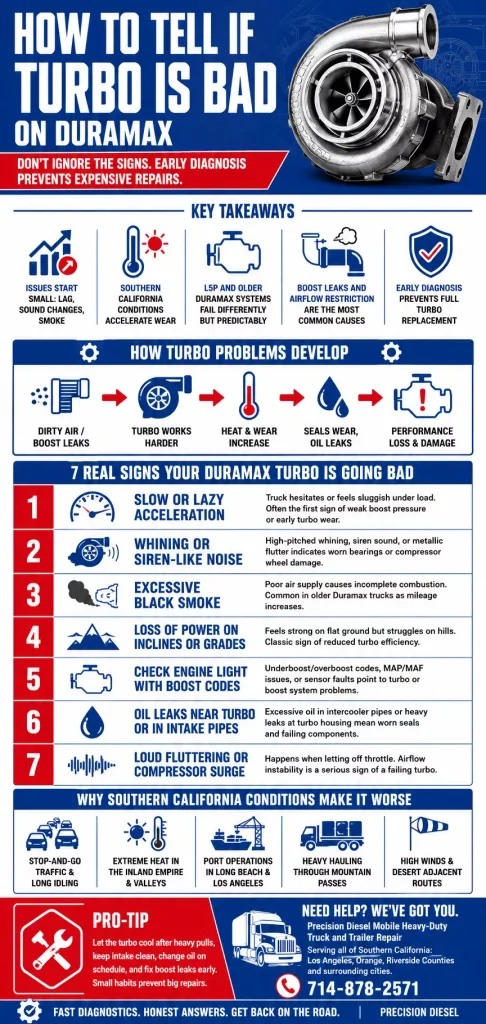
- Common signs of a bad Duramax turbo include slow acceleration, whining or siren-like sounds, black smoke, power loss on hills, boost-related check engine codes, oil leaks, and compressor surge.
- Most issues come from boost leaks, heat, sensor or airflow problems, and wear that builds up gradually over time.
- Driving conditions like heavy traffic and heat can speed up wear, so catching symptoms early helps avoid full turbo replacement and major engine damage.
Key takeaways
- How To Tell if Turbo is Bad on Duramax issues usually start small: lag, sound changes, smoke
- Southern California driving conditions accelerate wear
- L5P and older Duramax systems fail in different but predictable ways
- Boost leaks and airflow restriction are the most common causes
- Early diagnosis prevents full turbo replacement
Right from the start, this is something a lot of diesel owners in Southern California end up dealing with at the worst possible time… a truck that just doesn’t feel right under load. And if you’re running a workhorse like a Silverado HD or GMC Sierra, it usually shows up as power loss, weird noise, or that sluggish feeling when you hit the freeway on-ramp.
This guide is built around real-world field experience from working with fleets and drivers through Precision Diesel Mobile Heavy-Duty Truck and Trailer Repair, a Southern California service team that handles everything from roadside breakdowns to full diagnostic work across Los Angeles County, Orange County, Riverside County, and surrounding industrial corridors. You’ll see how how to tell if turbo is bad on duramax actually shows up in day-to-day driving, not just theory.
And yeah, this is especially relevant if you’re running long routes through the 405, I-5, SR-91, or hauling freight near the Port of Long Beach or Port of Los Angeles. Those conditions… they beat on a turbo hard.
The real issue behind Duramax turbo problems in Southern California
Modern Duramax engines are strong. No question. But heat, traffic, and constant load cycles around places like Santa Ana, Anaheim, Irvine, and the Inland Empire create stress most trucks don’t see in lighter duty regions.
When someone asks how to tell if turbo is bad on duramax, it usually comes after weeks of small warning signs.
On newer trucks like the 2020 Silverado HD or GMC Sierra with the L5P, the system is smarter, but not immune. And on older models like the 2005 or 2007 Duramax platforms, turbo wear shows up even faster because the systems are simpler and less protected.
We’ll break all that down in a way that actually makes sense on the road.
Quick reality check on Duramax generations and common issues
Before jumping into symptoms, it helps to understand the pattern across model years.
Drivers dealing with 2005 chevy 2500hd duramax problems or 2005 chevy silverado 3500 duramax problems often report early turbo lag and boost leaks as mileage climbs past 150k.
Same story shows up in:
- 2005 gmc 3500 duramax problems
- 2007 chevy 2500hd duramax problems
- 2009 gmc duramax problems
- 2011 chevrolet duramax problems
- 2013 gmc duramax problems
- 2017 duramax problems
- 2020 duramax problems
Each generation improves, but wear patterns stay familiar. Airflow, oil delivery, and heat management are always the core battle.
On newer duramax l5p problems, especially in the 2020+ trucks, turbo systems are electronically controlled and more sensitive to sensors, soot buildup, and boost leaks.
Even chevrolet duramax diesel problems and gm duramax diesel problems often circle back to airflow restriction or failing turbo components.
7 real signs your Duramax turbo is going bad
Here’s where things get practical. These are the patterns techs actually see when diagnosing duramax diesel turbo problems in the field.
1. Slow or lazy acceleration under load
This is usually the first thing drivers notice.
You step into the throttle merging onto the 405 or climbing out of Long Beach traffic… and the truck just doesn’t respond like it used to.
That hesitation often ties back to weak boost pressure or early-stage turbo wear.
It’s one of the clearest answers to how to tell if turbo is bad on duramax without needing tools right away.
2. Whining or siren-like turbo noise
A healthy turbo has a smooth spool sound. When it starts to fail, it changes tone.
You might hear:
- High pitched whining
- Siren noise under acceleration
- Metallic flutter when letting off throttle
This shows up often in duramax turbo problems and even gm duramax problems where compressor wheels start wearing unevenly.
In severe cases, it can lead to severe turbocharger damage if ignored.
3. Excessive black smoke from exhaust
This one is hard to miss, especially when pulling out of job sites in places like Fontana or Commerce.
Black smoke usually means incomplete combustion due to poor air supply.
That points directly back to turbo airflow issues or boost leaks.
This is also common in older trucks like:
- 2005 gmc diesel problems
- 2007 chevy diesel problems
- 2009 chevy diesel problems
4. Loss of power on inclines or freeway grades
Southern California has its share of stress points:
- Cajon Pass
- Grapevine (I-5)
- Ortega Highway
If your truck feels strong on flat ground but weak on climbs, that’s a classic turbo efficiency drop.
It’s one of the more overlooked chevy diesel engine problems because drivers assume it’s fuel-related.
But in many cases, it’s air delivery.
5. Check engine light with boost-related codes
Modern Duramax systems throw codes when boost targets aren’t met.
Common triggers show up in:
- L5P sensors
- MAP/MAF readings
- Underboost or overboost conditions
This connects heavily with l5p duramax problems and gm duramax diesel problems in newer trucks.
Some drivers try quick resets or even look up lp5 error fix, but that’s usually temporary if the turbo is actually failing.
6. Oil leaks near turbo housing or intercooler piping
Oil film inside charge pipes is sometimes normal… but heavy buildup is not.
When seals inside the turbo wear out, oil starts slipping into the intake system.
That leads to:
- Smoke
- Sludge buildup
- Reduced efficiency
This is a frequent issue in chevy duramax engine problems on higher mileage trucks.
7. Loud fluttering or compressor surge
This happens when airflow becomes unstable.
You hear it when letting off throttle quickly, especially at highway speeds near El Segundo or Torrance freight corridors.
It’s a sign the turbo is struggling to maintain consistent pressure.
At this stage, most techs already consider it a failing unit.
Why Southern California conditions make turbo problems worse
This part gets overlooked a lot.
Stop-and-go traffic in Los Angeles, long idle times near ports, and hot inland temps in Riverside County all create the perfect environment for turbo wear.
Add in:
- Constant short trips in Anaheim or Garden Grove
- Heavy hauling through Ontario logistics zones
- Heat soaking in Inland Empire summers
- Wind stress in desert-adjacent routes
And you get faster turbo fatigue.
Even newer 2020 duramax problems often show up earlier here than in cooler regions.
Real talk: L5P Duramax turbo behavior
The L5P platform is strong, but sensitive.
With l5p problems, it’s not always mechanical failure. Sometimes it’s:
- Sensor drift
- Boost control issues
- EGR-related airflow restriction
Still, when airflow drops consistently, you end up back at the same question: how to tell if turbo is bad on duramax.
And the answer doesn’t change much… it shows up in performance first.
Mobile diesel diagnostics in the field
When a truck breaks down near Santa Ana, Downey, or even deeper into the Inland Empire, the process is usually straightforward.
A proper diagnostic approach checks:
- Boost pressure under load
- Turbo shaft play
- Intake restriction
- Intercooler leaks
- Sensor feedback loops
This is where mobile service matters. A truck sitting in Carson or Compton doesn’t always make it to a shop easily, especially if it’s hauling time-sensitive freight.
That’s why Precision Diesel Mobile Heavy-Duty Truck and Trailer Repair focuses on bringing diagnostics directly to the truck instead of forcing downtime at a shop.
Preventing turbo failure before it gets expensive
Most turbo issues don’t happen overnight.
They build up from:
- Ignored air leaks
- Delayed oil changes
- Dirty air filters
- Excessive idling in traffic-heavy zones like Los Angeles and Long Beach
Simple habits help:
- Let the turbo cool after heavy pulls
- Keep intake system clean
- Fix boost leaks early
- Don’t ignore early hesitation
This applies across all platforms, from chevrolet duramax problems to newer gm duramax problems.
Common confusion: turbo vs fuel vs transmission
A lot of drivers mistake turbo issues for:
- Transmission slipping
- Fuel filter clogging
- DEF system issues
But when acceleration feels “flat” and boost never builds right, it usually circles back to airflow.
That’s why understanding how to tell if turbo is bad on duramax saves time and money.
Where Precision Diesel fits into all of this
A lot of what you just read shows up daily on the road across Orange County, Los Angeles County, and deeper into Riverside County. From Long Beach port trucks to fleet vehicles moving through Anaheim, Irvine, and Fontana logistics hubs, turbo issues don’t wait for a convenient time.
That’s where Precision Diesel Mobile Heavy-Duty Truck and Trailer Repair comes in. When trucks start showing symptoms tied to how to tell if turbo is bad on duramax, the goal isn’t just guessing. It’s getting eyes on it fast, whether it’s roadside near Norwalk, a yard in Santa Fe Springs, or a breakdown call in Ontario.
With over a decade of field experience working on chevy diesel truck problems, gm duramax problems, and modern l5p duramax problems, the focus stays simple… find the issue, explain it clearly, and get the truck moving again.
If you’re stuck somewhere between LA traffic and Inland Empire routes, support is available through Precision Diesel Mobile Heavy-Duty Truck and Trailer Repair at 714-878-2571, covering all of Southern California including Santa Ana, Anaheim, Long Beach, Riverside, and surrounding cities.
FAQ: real questions diesel drivers ask
Why does my Duramax feel slow but no codes show?
Early turbo wear or small boost leaks often don’t trigger codes right away.
Can I drive with a failing turbo?
You can, but it risks engine damage if the turbo starts leaking oil or breaks internally.
What causes Duramax turbo failure the most?
Heat, oil neglect, and long periods of high load driving through areas like Cajon Pass or Grapevine.
Is turbo replacement always needed?
Not always. Some duramax diesel turbo problems come from hoses, sensors, or clamps.
How long should a Duramax turbo last?
Typically 120k–200k miles depending on maintenance and driving conditions.