
9 Powerful Fixes That Keep Southern California Trucks Moving
TL;DR
Truck failures usually start with small warning signs that get ignored. Loss of power, unusual smoke, overheating, warning lights, and rough performance often show up before major damage happens.
Mobile repairs and routine Diesel Truck Repair and Maintenance help reduce downtime, improve fuel efficiency, keep fleets compliant, and keep trucks running throughout Southern California routes.
Key Takeaways
- Small issues usually become major breakdowns if ignored
- Stop and go traffic creates extra wear on heavy-duty trucks
- Cooling systems matter more during Inland Empire heat
- DPF and EGR problems often begin with performance changes
- Mobile diesel repair reduces downtime significantly
- Preventive maintenance costs less than emergency repairs
- Drivers should perform quick daily inspections
- Engine diagnostics help find hidden issues early
When you’re hauling freight across Southern California, problems rarely happen at a convenient time. A truck doesn’t wait until you’re parked for the day. It happens while sitting in traffic on the I-405, crawling through the I-710 port routes, pulling a load over Cajon Pass, or stuck in line outside a distribution center in Fontana.
That reality is exactly why Diesel Truck Repair and Maintenance matters. Not as a checklist sitting in a binder somewhere, but as something that keeps trucks moving, deliveries on time, and drivers from losing hours or entire days.
At Precision Diesel Mobile Heavy-Duty Truck and Trailer Repair, our technicians spend a lot of time dealing with situations that start with something small. A warning light ignored for two weeks. A little extra exhaust smoke. An engine that feels slightly weaker climbing grades. Then suddenly the truck is sitting on the shoulder.
Most breakdowns don’t appear out of nowhere.
They usually leave clues first.
This guide walks through the real problems truck drivers and fleet operators run into every day across Southern California, what warning signs to watch for, and how practical Diesel Truck Repair and Maintenance helps avoid expensive downtime.
Why Southern California Beats Up Heavy Trucks Faster Than Most Drivers Realize
Truck drivers working through Southern California deal with conditions that quietly punish equipment every day.
Take a run from Long Beach to Ontario.
You leave the Port of Long Beach and head through the I-710 corridor. Traffic slows. You stop. Move twenty feet. Stop again. Repeat that for an hour.
Then temperatures rise in the Inland Empire.
Then you’re climbing grades.
Then you’re sitting in a distribution yard waiting for unloading.
That combination creates stress on:
- Cooling systems
- Fuel delivery systems
- Turbochargers
- Air intake systems
- Brake systems
- Suspension components
- Emissions control systems
Heavy traffic around Anaheim, Santa Ana, Irvine, Carson, Commerce, Vernon, Downey, and Fontana creates constant wear that many owner operators underestimate.
Routine Diesel Truck Repair and Maintenance becomes more important in Southern California because trucks aren’t operating under ideal conditions.
They’re operating under punishment.
Why Southern California Beats Up Heavy Trucks Faster Than Most Drivers Realize
According to federal transportation data, millions of commercial trucks operate across the United States every year, which means even small maintenance habits can create major differences in reliability and operating costs over time.
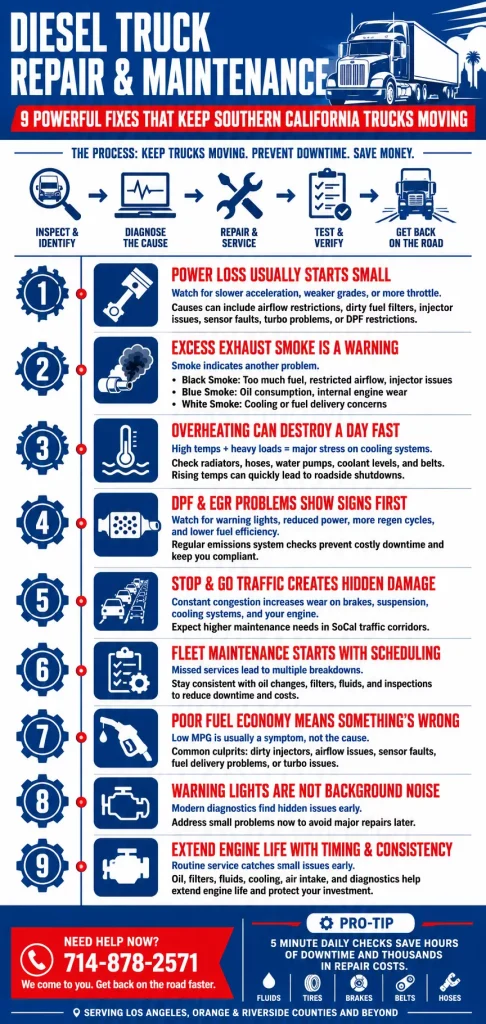
1. Power Loss Usually Starts Small
One of the most common situations our technicians see during diesel truck repair calls starts with drivers saying:
“The truck still runs… it just feels off.”
Maybe acceleration feels slower.
Maybe climbing the Grapevine on I-5 suddenly feels harder.
Maybe the truck needs more throttle than usual.
That small change often points toward:
- Airflow restrictions
- Dirty fuel filters
- Fuel injector issues
- Sensor performance problems
- Turbocharger issues
- Diesel particulate filter (DPF) restrictions
During Diesel Truck Repair and Maintenance, our technician will usually begin with engine diagnostics before replacing parts.
Because guessing gets expensive.
How Diesel Engines Actually Create Pulling Power
Most drivers care less about textbook explanations and more about one thing:
Can the truck pull hard when it needs to?
Diesel engines work differently than gasoline engines because they use compression ignition instead of spark plugs. Air gets compressed inside the cylinders until temperatures rise high enough for fuel injection to create combustion naturally.
That process produces strong torque output, which is why heavy trucks can move loaded trailers through places like Cajon Pass or climb grades along the Grapevine without constantly hunting for gears.
Our technicians sometimes see trucks arrive with complaints like:
“The engine still runs but it feels weak under load.”
In many cases, the issue isn’t a complete engine failure at all.
Instead, diesel engine performance starts dropping because something interrupts the combustion process:
- Restricted airflow
- Dirty fuel injectors
- Sensor faults
- Fuel delivery issues
- Turbocharger problems
Small imbalances in the fuel-to-air ratio can slowly reduce power and engine efficiency long before drivers notice obvious symptoms.
That’s why during Diesel Truck Repair and Maintenance, our technician will often inspect multiple systems instead of immediately replacing parts.
A technician typically checks:
Air filter maintenance
Restricted airflow can reduce engine combustion efficiency and lower power output.
Fuel filter inspection
Fuel delivery systems depend on clean fuel flow.
Turbocharger inspection
Turbochargers under heavy use can develop leaks or wear.
Sensor checks
Modern diesel engine diagnostics often reveal sensor issues that drivers never notice.
2. Excess Exhaust Smoke Is Trying To Tell You Something
Exhaust smoke matters.
Not because smoke itself is the problem.
Because smoke points toward another issue underneath.
Black smoke may suggest:
- Too much fuel
- Restricted airflow
- Fuel injector problems
Blue smoke may suggest:
- Oil consumption
- Internal engine wear
White smoke can sometimes indicate:
- Cooling system problems
- Fuel delivery concerns
- Combustion issues
Our team commonly sees this during heavy-duty truck repair work in Long Beach port routes and Commerce industrial areas where long idle periods and traffic congestion create added strain.
Ignoring smoke often turns smaller diesel repairs into larger engine repair jobs.
3. Overheating Can Destroy A Day Fast
Southern California summers are rough on heavy trucks.
Especially around Riverside County and Inland Empire routes.
High temperatures combined with loaded trailers create major stress on cooling systems.
Our technicians performing truck repair and maintenance commonly inspect:
- Radiators
- Hoses
- Water pumps
- Coolant levels
- Belt inspection
- Cooling system inspection
A truck climbing Cajon Pass with cooling issues can move from “slightly warm” to roadside shutdown surprisingly fast.
Warning signs usually include:
- Rising temperature gauges
- Coolant smells
- Reduced power
- Warning lights
Diesel Truck Repair and Maintenance Starts With Daily Checks
Drivers do not need an hour long inspection every morning.
Five minutes helps.
A practical diesel maintenance checklist should include:
Oil changes and fluid checks
Low fluid levels become expensive problems.
Tire pressure checks
Improper pressure creates wear and fuel loss.
Fuel filter inspection
Restricted fuel flow hurts engine efficiency.
Belt inspection
Cracks and wear matter.
Hose inspection
Small leaks grow.
Brake system inspection
Stopping systems are not optional.
Suspension maintenance
Heavy loads create suspension wear over time.
Routine checks reduce vehicle downtime and improve vehicle reliability.
Safety Systems Matter Just As Much As Engine Systems
A surprising number of roadside problems don’t actually start inside the engine.
Our team routinely sees issues involving brakes, suspension components, tires, and cooling systems creating the first signs of trouble.
Routine inspections usually include:
- Tire pressure checks
- Brake system inspection
- Suspension maintenance
- Cooling system inspection
- Hose inspection
- Belt inspection
Drivers moving through Los Angeles congestion or distribution routes near Fontana and Commerce create repeated stress on these systems every day.
Small wear patterns become larger failures when ignored long enough.
4. DPF And EGR Problems Usually Give Warning Signs First
Modern emissions systems help trucks meet environmental regulations and air quality standards.
But they also create repair situations drivers see regularly.
Common components include:
- Diesel particulate filter (DPF)
- Exhaust gas recirculation (EGR)
- Catalytic converter
- Emissions control systems
Truck operators around the Port of Los Angeles and Port of Long Beach deal with strict emissions compliance expectations and gate protocols.
Problems often show up as:
- Reduced engine efficiency
- Warning lights
- Increased regeneration cycles
- Lower fuel efficiency
- Reduced power output
During commercial diesel repair, our technician will usually run engine diagnostics and inspect the system instead of simply replacing components.
5. Stop And Go Traffic Creates Hidden Damage
Southern California freeway congestion quietly increases wear.
The merge points around Los Angeles traffic are especially rough.
Repeated acceleration and braking affect:
- Brake systems
- Suspension systems
- Cooling systems
- Engine efficiency
- Fuel usage
Fleet operators managing trucks in Torrance, Huntington Beach, Buena Park, Garden Grove, Cerritos, and Fullerton often notice repair frequency increase with high traffic routes.
Consistent fleet maintenance becomes extremely important.
Why Mobile Diesel Repair Changes The Situation
A truck sitting still costs money.
That’s the simple reality.
A truck parked on the shoulder near El Segundo, Hawthorne, or Santa Monica isn’t generating revenue.
Mobile diesel repair reduces the delay between problem and repair.
Instead of towing a truck somewhere first, a technician comes directly to the truck.
During emergency diesel truck repair, our team typically arrives and starts with:
- Engine diagnostics
- System inspection
- Electrical testing
- Fuel system checks
- Repair recommendations
- Repair completion if possible onsite
Mobile diesel repair is especially useful around Ontario logistics corridors, port routes, and warehouse areas where time matters.
6. Fleet Maintenance Problems Usually Begin With Scheduling Gaps
Fleet managers already know this problem.
One truck misses service.
Then another.
Then suddenly multiple trucks need repairs at once.
Effective diesel fleet maintenance strategies usually involve:
- Routine maintenance scheduling
- Preventive maintenance tracking
- Filter replacements
- Fluid checks
- Diesel engine maintenance
- Component inspections
Consistent fleet diesel maintenance often reduces major breakdown events.
7. Fuel Economy Problems Usually Mean Something Else Is Wrong
Poor fuel efficiency rarely appears without another cause.
Our technicians performing diesel troubleshooting often discover:
- Dirty injectors
- Airflow restrictions
- Sensor failures
- Fuel delivery problems
- Turbocharger issues
Improving diesel engine efficiency usually begins with finding the source rather than chasing symptoms.
8. Warning Lights Shouldn’t Become Background Noise
Drivers see warning lights so often that eventually some get ignored.
Until they can’t.
Modern diesel engine diagnostics can identify issues affecting:
- Fuel injectors
- Crankshafts
- Pistons
- Air intake systems
- Cooling systems
- Sensor performance
The earlier a problem gets identified, the lower diesel repair costs usually stay.
9. Extending Diesel Engine Lifespan Is Mostly About Timing
People often assume advanced diesel repairs are unavoidable.
Not always.
Regular preventive diesel truck maintenance often helps extend engine lifespan by addressing problems earlier.
Routine service commonly includes:
- Oil filter replacement
- Filter replacements
- Fluid checks
- Cooling system inspection
- Air filter maintenance
- Engine diagnostics
Long service life usually comes from consistency.
Not luck.
Advanced Repairs Usually Start With Diagnostics, Not Parts
A lot of people imagine major repairs beginning with engines getting pulled apart.
Usually that isn’t how it happens.
Modern heavy-duty trucks rely on sensors and control modules that constantly monitor system performance. During advanced diesel repairs, our technicians frequently use diagnostic equipment to evaluate airflow readings, fuel pressure, injector timing, emissions data, and electrical signals.
Sometimes the issue turns out to be a failing sensor.
Sometimes it’s injector timing.
Other times the engine may need recalibration after component replacement or software updates.
Replacing parts before confirming the cause can become expensive quickly.
Accurate diesel troubleshooting helps reduce unnecessary labor and keeps trucks from returning with the same issue weeks later.
Schedule your Diesel Truck Repair and Maintenance
Truck drivers across Southern California deal with enough already. Port traffic in Long Beach. Congestion through Los Angeles County. Heat in Riverside County. Delays around Anaheim and Santa Ana. Long runs through Orange County and warehouse routes stretching from Commerce to Fontana.
Keeping trucks moving usually comes down to catching small issues before they become major problems.
Precision Diesel Mobile Heavy-Duty Truck and Trailer Repair works directly where trucks operate every day. Our technicians regularly respond throughout Los Angeles County, Orange County, Riverside County, and surrounding Southern California routes. Whether a truck is moving through the South Bay, the Gateway Cities, or industrial areas around Vernon and Ontario corridors, the goal stays simple. Diagnose the issue clearly, reduce downtime, and get drivers moving again.
Many drivers first hear about Precision Diesel Mobile Heavy-Duty Truck and Trailer Repair during an emergency situation when they’re trying to find a dependable diesel mechanic shop near me. Others already know our technicians from routine work performed through our locations in La Palma, Huntington Beach, El Segundo, and Newport Beach. Either way, the work itself stays practical. Keep trucks running and keep loads moving.
Call 714-878-2571 whenever the truck stops acting right before it decides to stop altogether.
External Resources
Federal emissions guidance: https://www.epa.gov/regulations-emissions-vehicles-and-engines
Commercial vehicle safety information: https://www.fmcsa.dot.gov
FAQ
What are signs your diesel engine needs repair?
Common warning signs include power loss, rough starts, unusual exhaust smoke, warning lights, overheating, increased fuel usage, or reduced torque output. Most diesel engine repair situations start with smaller symptoms before becoming major failures.
How often should preventive diesel truck maintenance happen?
A routine diesel engine maintenance schedule varies by mileage, engine type, operating conditions, and load demands. Trucks running port routes, city traffic, or frequent stop and go conditions often require more frequent service.
How diesel truck engines work affects maintenance?
Diesel engines rely on compression ignition and controlled engine combustion rather than spark plugs. Components like fuel injectors, pistons, crankshafts, turbochargers, and fuel-to-air ratio management all influence diesel engine functioning.
What causes common diesel engine problems?
Common diesel engine problems include clogged filters, injector issues, cooling system failures, emissions system restrictions, airflow restrictions, and sensor faults.
Can mobile repair handle roadside emergencies?
Many professional diesel repair service situations can be completed onsite. Mobile repair often addresses diagnostics, electrical issues, fuel problems, cooling system repairs, and many forms of semi-truck repair.
