
TL;DR
Backing a trailer is easier with a simple bottom-of-the-wheel steering method where your hand direction matches trailer movement. Success depends on slow, small corrections, heavy mirror use, and understanding how different trailer types respond to steering. Safety checks and regular practice are essential to build confidence and prevent mistakes.
Key Takeaways
- Use the bottom-hand steering method to make trailer direction more intuitive
- Make small, gradual steering inputs instead of sharp or repeated corrections
- Rely heavily on side mirrors to track trailer movement and alignment
- Different trailers behave differently based on length, weight, and design
- Always complete a pre-backing safety check of hitch, lights, tires, and chains
- Practice with smaller trailers first before moving to larger or heavier rigs
- Avoid common mistakes like oversteering, rushing, and focusing on only one mirror
- Visual aids like a rear antenna can improve awareness in tight spaces
- Consistent maintenance and safe vehicle condition support better towing performance
- Professional support like Precision Diesel Repair can help keep tow vehicles road-ready
Back up a trailer is difficult, be it a boat trailer, utility trailer, camper, or tractor trailer. Most drivers find this very useful skill daunting because they don’t know how to turn or control the direction of their trailer. But fear not! We have a simple yet effective technique that will work with any type of trailer and help you back up with confidence.
Those hands-on skills translate to all trailer sizes and styles, from small utility trailers to large semi-trucks. In fact, these same techniques apply whether you’re handling tractor trailer semi trucks, 18 wheeler trucks, or smaller trailer trucks used for everyday hauling.
Follow these tips from experts, and you’ll confidently tackle any backing situation—making towing a safer, more efficient experience.
Understanding Different Trailer Types and Their Backing Challenges
Whether you are hauling cargo or taking your boat to the lake, each trailer type presents unique backing challenges. Boat trailers tend to be longer and require extra attention due to their weight distribution when loaded. Utility trailers tend to be shorter and more sensitive to steering input. Camper trailers’ height and length make for bigger blind spots, while tractor-trailers require precise control due to their large size.
Shorter trailers respond quicker to steering input, which can make them more difficult for a novice. This is why many drivers practice with a mini tractor trailer or small trailer truck before moving on to bigger rigs like semi trucks and trailers or full-size truck tractor semi trailers.
Longer trailers are more stable but require wider turns. Height differences affect your visibility and use of mirrors, and weight distribution affects how your trailer responds during backing maneuvers.
The wheelbase of your trailer affects its turning radius, loaded vs. unloaded trailers handle differently, and mirror placement needs to be adjusted for the width of the trailer. Different hitching systems will affect how you turn. Knowing what type of trailer you have helps you know how it should handle and adjust your backing technique accordingly. A utility trailer may require more rapid steering corrections, while a camper trailer requires more gradual inputs and wider turns.
Essential Safety Checks Before You Start Backing Up
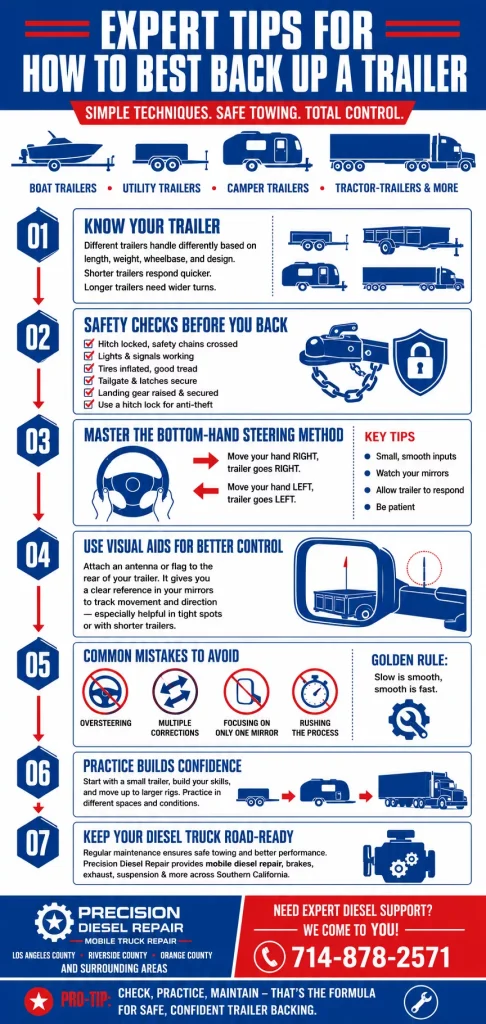
The first thing you must consider when backing up any trailer is safety. A proper pre-backing inspection will ensure the operation goes smoothly without accidents. For the hitch connection, secure the trailer onto the ball hitch with proper locking, attach safety chains in a crossed pattern, connect the light cord for proper signal operation, and raise and secure the landing gear.
For components, check all tires for adequate inflation and tread condition, tail lights and turn signals for operation, tailgate latch and security, and the hitch connection’s security. For anti-theft protection, install a safety lock on the hitch latch, consider a keyed lock pin system instead of a simple cotter pin, and double-check the engagement of locks before proceeding.
A thorough check takes only a few minutes to complete but can save hours of possible trouble. Whether you’re towing a 16ft trailer, a 20 ft flatbed trailer, or even a 24ft enclosed trailer, checking the weight capacity and ensuring proper tire inflation is just as important as the hitch connection itself.
Many drivers hurry through these checks, but each of these components is truly important for safe trailer operation. With practice, your safety inspection becomes second nature, and you will be able to recognize potential problems before they become problems on the road. Remember, a properly secured trailer is peace of mind, allowing you to focus on the backing maneuver at hand. Not only are these safety precautions important for your own equipment but also for other road users around you.
Mastering the Art of Trailer Backing with Expert Techniques
A simple but efficient steering wheel trick is the key to backing up any trailer. Where many drivers have problems figuring out which way to turn the wheel, this works universally—boat trailer, utility trailer, camper, or even tractor-trailer.
The Bottom-Hand Steering Method
Place your hand at the bottom of the steering wheel. When you turn your hand to the right, the trailer goes right, and when you turn your hand to the left, the trailer goes left. This intuitive approach takes away the confusion of traditional steering methods. When you grasp the bottom of the wheel, your hand movements correspond directly with the direction of the trailer, creating a natural connection between your actions and the trailer’s response.
Key Tips for Precise Control
Do not oversteer – small, controlled movements work best. Keep your eyes on your mirrors to track the trailer’s position, make gradual adjustments rather than sharp turns, and allow the trailer to respond before making additional corrections. Your mirrors become your most valuable tools during this process. They provide crucial feedback about your trailer’s position and movement. Watch them carefully to understand how your steering inputs affect the trailer’s path.
Common Mistakes to Avoid
The most common errors are overcorrection—turning the wheel too far—making more than one correction before you see what your first correction does, focusing on just one mirror, and trying to rush the process. The technique remains the same, whether you are towing a small utility trailer or a large semi-truck. Even with automatic 18 wheelers, cabover sleeper trucks, or modern semi trucks, the bottom-hand steering method gives you precise control over the trailer’s movement.
If you are new at backing a trailer, begin with a small trailer to build your confidence and muscle memory. The skills will transfer to larger rigs as you gain experience. Remember, smooth and steady movements make for the most controlled backing experience. Your patience and attention to these basic techniques will help you master the art of trailer backing with confidence and precision.
Using Visual Aids to Improve Backing Control
The right help can make the sometimes-daunting task of backing up a trailer much easier, and this simple trick can dramatically make it easier to see where your trailer is. The trick is to attach an antenna to the rear of your trailer. This creative solution makes tracking the trailer’s movement much easier through your side mirrors.
The antenna serves as a visual reference point, sticking up from the back of your trailer. As you back up, you can see through your mirrors how the antenna on the trailer moves, knowing precisely where your trailer is and what direction it’s going. This trick works best for backing shorter trailers, which are harder to gauge through the mirrors, maneuvering in tight spots, learning to back up a trailer for the first time, and working with types of trailers that you’re not accustomed to. The antenna technique complements good steering habits and turns an otherwise tricky proposition into something approaching an effortless action.
This trick works for everything from a motorcycle trailer to a semi equipment trailer or even larger big rig trailers used for cross-country transport.
Professional Trailer Backing Tips for Diesel Trucks in Southern California
Diesel operators often rely on proven backing a tractor trailer tips to maintain control during tight yard and jobsite movements. Proper coordination between steering input and trailer response is especially important for heavy-duty diesel trucks operating in Southern California’s busy transport routes.
Experienced drivers also rely on backing up a trailer tips that emphasize smooth corrections and steady mirror use to reduce swing and jackknife risk. These fundamentals are commonly reinforced during fleet training and mobile diesel service support visits across Los Angeles County, Riverside County, and Orange County.
Practical field experience highlights how tips for backing a tractor trailer help improve precision when handling long-haul diesel combinations under pressure. Consistent application of these methods supports safer maneuvering during loading dock entry and roadside adjustments.
Many professionals follow structured tips for backing a trailer to maintain alignment when operating different trailer sizes in varied working conditions. These practices are especially useful for diesel-powered fleets that require dependable performance during repeated stop-and-go routing.
Drivers handling watercraft transport benefit from tips for backing up a boat trailer when positioning trailers on uneven ramps or tight launch areas. These techniques help reduce strain on diesel tow vehicles while improving control during launch and retrieval operations.
A reliable trailer backing guide is often used by diesel operators to reinforce safe movement patterns during daily commercial hauling tasks. This approach supports better spatial awareness and helps reduce unnecessary wear on towing components.
Fleet technicians and operators frequently reference trailer backing tips to maintain consistent control during repetitive backing maneuvers in industrial yards. These habits align with proper diesel maintenance practices that keep trucks operating safely under load.
Gaining Experience Through Practice and Professional Help for Maintenance Needs
Practice makes perfect when it comes to backing up trailers. Whether you’re fresh off the bat with your CDL or a seasoned driver, it’s well worth the time to invest in practicing with different types of trailers. Begin with a small utility trailer attached to your car; learning the basic principles before moving on to larger rigs is an excellent method.
The beauty of starting small is that it presents a low-pressure environment. It’s where you can make mistakes, adjust your approach, and build confidence without the stress of handling bigger equipment. Once you are comfortable with the smaller trailers, those same principles apply to semi-trailers and larger rigs.
Professional Support for Safe Towing
Your tow vehicle should be at its best for the safe operation of a trailer. Precision Diesel Repair offers full-service mobile support throughout Southern California, including diesel engine repair, exhaust system maintenance, brake repair services, and suspension system checks. Our mobile truck repair team covers Los Angeles County, Riverside County, and Orange County, along with surrounding areas. We bring our expertise in maintenance directly to you, ensuring your vehicle is always ready for towing operations.
Regular maintenance checks are very important for safe towing. From truck & trailer world fleets to single car trailers, staying on top of service helps keep your semi trailer trucks, simi trucks, and tractor-trailors ready for the road. Never wait for problems to develop; preventive care helps to avoid unexpected issues during critical backing maneuvers.
Your Journey Towards Becoming A Pro At Backing Up Trailers Begins Now!
Making that simple move of putting your hand at the bottom of the steering wheel brings an instinctual relationship to your movements and the direction of the trailer. Try it, and before you know it, you will have mastered how to back up a trailer. Your safety while driving depends upon your driving ability and vehicle condition.
Keeping your diesel vehicle in top shape is our commitment for all towing purposes at Precision Diesel Repair. Our specialist mobile repair service comes to you anywhere across Southern California, ensuring your vehicle runs reliably whenever and wherever you hit the road.
Start with smaller trailers before moving to larger ones and keep your diesel vehicle maintained for safe towing. For professional assistance with your diesel vehicle, call Precision Diesel Repair at (714) 878-2571 for top-rated mobile truck repair services throughout Los Angeles County, Riverside County, Orange County, and beyond.