

A diesel particulate filter (DPF) traps soot and particulate matter produced by your engine, and when it fails, your truck fails with it. Semi truck DPF problems are among the most expensive, most misdiagnosed, and most preventable issues owner-operators and fleet managers face today.
Key Takeaways
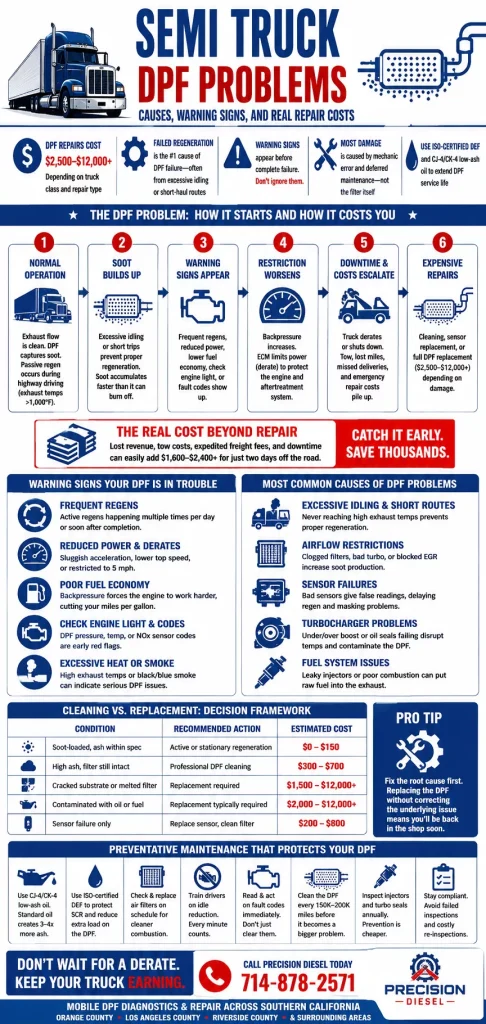
- DPF failures can cost anywhere from $2,500 to over $12,000 depending on truck class and repair type.
- Failed regeneration is the single most common cause of DPF failure, often triggered by excessive idling or short-haul routes.
- Warning signs like frequent regens, reduced power, and poor fuel economy appear well before a full failure.
- Most DPF damage is caused by mechanic error and deferred maintenance, not the filter itself wearing out.
- Using ISO-certified DEF and CJ-4/CK-4 low-ash oil significantly extends DPF service life.
- Mobile diagnostic and repair services can catch DPF issues early, before a derate sidelines your truck.
How a DPF System Actually Works on a Semi Truck
A diesel particulate filter sits in the exhaust stream and physically captures soot particles before they exit the tailpipe. On a Class 8 semi truck, the DPF works alongside the diesel oxidation catalyst (DOC) and the selective catalytic reduction (SCR) system, which uses diesel exhaust fluid (DEF) to reduce nitrogen oxide emissions. Together, these components make up the aftertreatment system that modern trucks depend on to meet EPA standards.
The DPF must periodically burn off accumulated soot through a process called regeneration. There are two types: passive regeneration, which happens automatically during sustained highway driving when exhaust temperatures exceed 1,000°F, and active regeneration, which the engine management system initiates when passive regen isn’t happening frequently enough. As detailed in this overview from 4 State Trucks, understanding how regeneration works is essential to understanding why so many filters fail prematurely.
One thing regeneration cannot remove is ash, the non-combustible residue left behind by engine oil additives. That ash accumulates over time and requires physical cleaning, typically every 150,000 to 200,000 miles, or outright replacement when cleaning is no longer effective.
Why Semi Truck DPF Problems Turn Expensive So Fast
The real financial danger isn’t the repair itself. It’s the cascading effect. When a DPF begins to fail, the engine management system triggers a derate, limiting your truck to reduced power or even a crawl. That means lost miles, missed deliveries, and in many cases, a truck parked on the side of the road while you negotiate emergency service.
A completely clogged DPF can run you $3,000 to $5,000 in emergency repair costs alone. A full DPF replacement on a Class 8 truck ranges from $5,000 to over $12,000, depending on the brand and whether the DOC and SCR components also need attention. For context, research from TruckClub confirms that light-duty diesel pickups see costs starting around $2,500, while commercial trucks can exceed $12,000.
Beyond the direct repair bill, add tow costs, expedited freight fees if a load misses its window, and lost per-mile revenue. For an owner-operator running at $2.00 per mile, even two days of downtime can mean $1,600 to $2,400 in lost gross revenue. That is not a small number.
The most preventable part of this equation is that most DPF failures don’t happen without warning. They follow a predictable symptom path that, if recognized early, can reduce repair costs dramatically.
The root causes of semi truck DPF problems allows drivers to address minor issues before severe damage occurs. Fleet managers who proactively monitor semi truck DPF problems can protect their bottom line against unexpected towing fees.
Warning Signs Your DPF Is in Trouble
Regeneration Is Happening More Frequently Than Normal
If your truck is triggering active regen cycles multiple times per day, or if the regen warning light appears shortly after a cycle completes, the filter is not cleaning itself efficiently. This is often the first visible symptom.
Reduced Power and Engine Derates
Modern trucks are programmed to protect the aftertreatment system. When soot levels rise beyond a safe threshold, the ECM steps in and limits throttle response. You may notice sluggish acceleration, reduced top speed, or a full derate that restricts you to 5 mph. This is not a suggestion to address the issue later. It is an immediate mechanical warning.
Fuel Economy Dropping Without Explanation
A restricted DPF creates backpressure in the exhaust system. That backpressure forces the engine to work harder for the same output, which translates directly into worse fuel mileage. If your miles per gallon have dropped noticeably without a change in load, route, or driving habits, the DPF should be on your diagnostic list.
Check Engine Lights and Active Fault Codes
Fault codes related to DPF differential pressure sensors, exhaust temperature sensors, and NOx sensors are common early indicators. Many operators ignore these codes or clear them without diagnosing the root cause. According to troubleshooting data from Performance Diesel, ignored fault codes are one of the primary reasons small DPF issues escalate into full replacements.
Excessive Exhaust Heat or Visible Smoke
Unusually high exhaust temperatures or blue/black smoke coming from the stack can indicate incomplete combustion or a failing DPF. These symptoms are harder to miss but often appear later in the failure sequence.
The Most Common Causes of Semi Truck DPF Problems
Excessive Idling
Long-haul trucks that idle for extended periods never reach the exhaust temperatures needed for passive regeneration. Short-haul trucks and those running urban delivery routes face the same problem from a different angle: too many stops, not enough sustained speed. Both scenarios allow soot to accumulate faster than the DPF can burn it off.
If your drivers idle for more than 30 minutes at a stretch regularly, it is worth building driver training around idle reduction. Some fleets in California use idle reduction technology partly to protect their DPF systems and partly to comply with state emissions rules. For context on how California’s emissions environment affects your equipment, reading about what is the california diesel engine ban and its effects gives a clear picture of the regulatory backdrop Southern California operators face.
Short-haul delivery schedules often accelerate semi truck DPF problems due to frequent stops and low exhaust temperatures.
Routine air intake and turbocharger checks play a vital role in preventing semi truck DPF problems caused by incomplete combustion.
High-grade diesel fuel additives can help reduce semi truck DPF problems associated with rapid carbon buildup.
Airflow Restrictions
A clogged air filter, a malfunctioning turbocharger, or a blocked EGR system disrupts the combustion process. Poor combustion produces more soot per cycle, which accelerates DPF loading and shortens the time between cleaning intervals. Airflow maintenance is one of those areas where skipping a $30 filter change can cost you $8,000 later.
Sensor Failures
The differential pressure sensor measures soot load inside the DPF. If that sensor reads inaccurately, the ECM may not initiate active regen when it should, or it may trigger unnecessary derates. Temperature sensors play a similar role in managing regen cycles. A faulty sensor can mask a legitimate DPF problem right up until a full blockage occurs, as noted by Onsite Truck Arizona’s DPF diagnostic breakdown.
Turbocharger Problems
The turbo drives exhaust gases through the aftertreatment system at the right temperature and pressure. A failing turbo that underboosts or overboosts disrupts this balance. Under-boost situations result in lower exhaust temps, making passive regeneration impossible. Turbo seal failures can also push oil into the exhaust stream, contaminating the DPF with substances that don’t burn off during regen.
Fuel System Issues
Injectors that are worn or leaking can cause raw fuel to enter the exhaust stream. Fuel-contaminated DPFs often need replacement rather than cleaning because the hydrocarbons don’t ash out cleanly. Regular injector maintenance is directly tied to DPF longevity, and a detailed diesel maintenance approach should include keeping injectors within spec. You can also build a stronger maintenance foundation by understanding how often to change diesel oil, since low-ash CJ-4 and CK-4 oils are specifically formulated to reduce ash accumulation inside the DPF.
DPF Cleaning vs. Replacement: A Decision Framework
Not every DPF problem requires a new filter. Knowing when to clean and when to replace saves significant money.
| Condition | Recommended Action | Estimated Cost |
|---|---|---|
| Soot-loaded, ash within spec | Active regen or stationary regen | $0-$150 |
| High ash, filter still intact | Professional DPF cleaning | $300-$700 |
| Cracked substrate or melted filter | Replacement required | $1,500-$12,000+ |
| Contaminated with oil or fuel | Replacement typically required | $2,000-$12,000+ |
| Sensor failure only | Replace sensor, clean filter | $200-$800 |
Professional cleaning uses pneumatic or thermal methods to remove ash. A cleaned DPF that is returned to service can perform for another 150,000 to 200,000 miles if the underlying cause of the failure is also corrected. Replacing the filter without fixing the root cause, whether that is a bad injector, oil-burning engine, or excessive idle time, means you will be back in the same situation within months.
Preventative Maintenance That Actually Protects Your DPF
Proactive maintenance is where the real money is saved. The following steps give your DPF the best possible service life:
- Use the right oil. CJ-4 and CK-4 low-ash diesel engine oils are mandatory for DPF-equipped trucks. Standard oil produces three to four times more ash per gallon. This is not optional.
- Use ISO-certified DEF. Contaminated or diluted DEF degrades the SCR catalyst, increasing NOx output and placing extra load on the DPF.
- Check and replace air filters on schedule. Clean airflow means cleaner combustion, which means less soot.
- Train drivers on idle reduction. Set fleet-wide idle limits and monitor compliance with telematics.
- Read and act on fault codes immediately. Every code is a data point. Clearing without diagnosing is throwing money away.
- Schedule DPF cleaning at proper intervals. Don’t wait for a derate to prompt cleaning. Most manufacturers recommend cleaning every 150,000 to 200,000 miles.
- Inspect turbo seals and injectors annually. Both systems directly affect what enters the DPF.
Southern California fleets also face the added pressure of regulatory compliance. If you’ve ever failed a clean truck check, you know how quickly a DPF-related emissions failure creates problems beyond just the repair bill. Understanding the requirements of a clean truck check before your truck is inspected helps you avoid violations and costly re-inspection fees.
For more detailed technical reading on related diesel topics, the articles section from Precision Diesel covers a broad range of maintenance and compliance subjects worth bookmarking.
It’s also worth noting that something as seemingly unrelated as empty semi trailer weigh factors into route planning and load management, which in turn affects how often your truck operates in the highway speed range needed for passive regeneration.
The NIH’s research on diesel exhaust particulate matter confirms the importance of functioning DPF systems not just for compliance, but for public health outcomes connected to diesel emissions in densely populated areas like Southern California.
Establishing a routine maintenance protocol is the most reliable strategy for avoiding semi truck DPF problems altogether. Training drivers on effective idle management goes a long way in cutting down semi truck DPF problems across your fleet. Monitoring exhaust backpressure during standard inspections helps catch semi truck DPF problems in their earliest stages.
Things to Know
- DPF problems are the leading cause of unexpected downtime for Class 8 trucks in urban delivery and regional haul operations.
- Ash accumulation cannot be removed by regeneration. Physical cleaning is the only solution once ash reaches capacity.
- Trucks running CNG conversions or used biodiesel blends above B20 may experience accelerated DPF loading due to combustion chemistry differences.
- A derate is not always DPF-specific. NOx sensor failures, SCR catalyst degradation, and DEF dosing problems can all trigger similar symptoms. Accurate diagnosis before replacing parts saves thousands.
- EPA emissions standards for heavy-duty diesel trucks continue to tighten, making functional aftertreatment systems more critical than ever.
- The Mayo Clinic’s data on air quality and respiratory health underscores why diesel particulate emissions matter beyond just regulatory compliance.
- Diagnostic scans are essential for identifying hidden semi truck DPF problems before the engine management system enters derate mode.
- Mobile repair specialists can frequently resolve semi truck DPF problems directly at your yard or dispatch location.
Get Your DPF Diagnosed Before It Costs You More Than It Should
Semi truck DPF problems don’t wait for a convenient moment. If your truck is showing warning signs right now, every day without a diagnosis is a day closer to a derate and a full-shutdown repair bill. Precision Diesel operates as a mobile diesel repair and fleet maintenance provider across Orange County, Los Angeles County, Riverside County, and surrounding areas in Southern California. With over 20 years of experience, the team handles DPF filter cleaning, EGR cleaning, engine diagnostics, exhaust system repair, and full preventative maintenance programs that come to your location.
Call Precision Diesel today at (714) 878-2571 to schedule mobile DPF diagnostics and keep your truck earning, not sitting.
Frequently Asked Questions
How do I know if my semi truck DPF needs cleaning or replacement?
If your DPF is soot-loaded and the substrate is intact, professional cleaning is usually sufficient. If the filter is cracked, melted, or contaminated with oil or fuel, replacement is typically required.
A cleaning service costs $300 to $700, while replacement on a Class 8 truck can run $5,000 to $12,000 or more. The best way to determine which option applies is a differential pressure test and a visual inspection of the filter substrate.
Can I drive my semi truck when the DPF warning light is on?
You can often continue driving briefly when the initial warning light appears, but you should not ignore it or continue operating for extended periods without addressing it.
Modern trucks will escalate from a warning light to a derate and eventually a complete engine shutdown if the DPF issue goes unresolved. Acting on the warning light early typically limits your repair to a cleaning or sensor replacement rather than a full filter replacement.
How often does a semi truck DPF need to be cleaned?
Most manufacturers recommend DPF cleaning every 150,000 to 200,000 miles, but trucks that idle frequently or run short routes may need cleaning more often.
Your actual cleaning interval depends on engine condition, oil type, operating profile, and fuel quality. Monitoring your regen frequency is a practical way to track when cleaning is approaching.
What is the most common cause of DPF failure in semi trucks?
Failed regeneration, driven by excessive idling or too many short-haul trips, is the most common root cause of DPF failure in commercial trucks.
When a truck never sustains the highway speeds needed for passive regeneration, soot accumulates faster than active regen can manage. This creates a buildup cycle that eventually results in a blocked filter.
Does engine oil type really affect DPF lifespan?
Yes. Using conventional diesel oil in a DPF-equipped truck produces significantly more ash than CJ-4 or CK-4 low-ash formulations, shortening the time between required cleanings.
Low-ash oils are specifically engineered to minimize the residue that accumulates in the DPF. Switching to the correct oil specification is one of the highest-return, lowest-cost changes a fleet can make.
The Bottom Line on Semi Truck DPF Problems
Semi truck DPF problems follow a predictable pattern: warning signs appear, operators delay action, costs escalate. The difference between a $500 cleaning and a $10,000 replacement is almost always timing. Catching the issue at the warning light stage, not the derate stage, is what separates operators who control their maintenance costs from those who react to emergencies.
Your next step is straightforward. If your truck has a check engine light, is triggering frequent regens, or has shown any drop in power or fuel economy, contact Precision Diesel at (714) 878-2571 for mobile DPF diagnostics anywhere in Southern California.
